

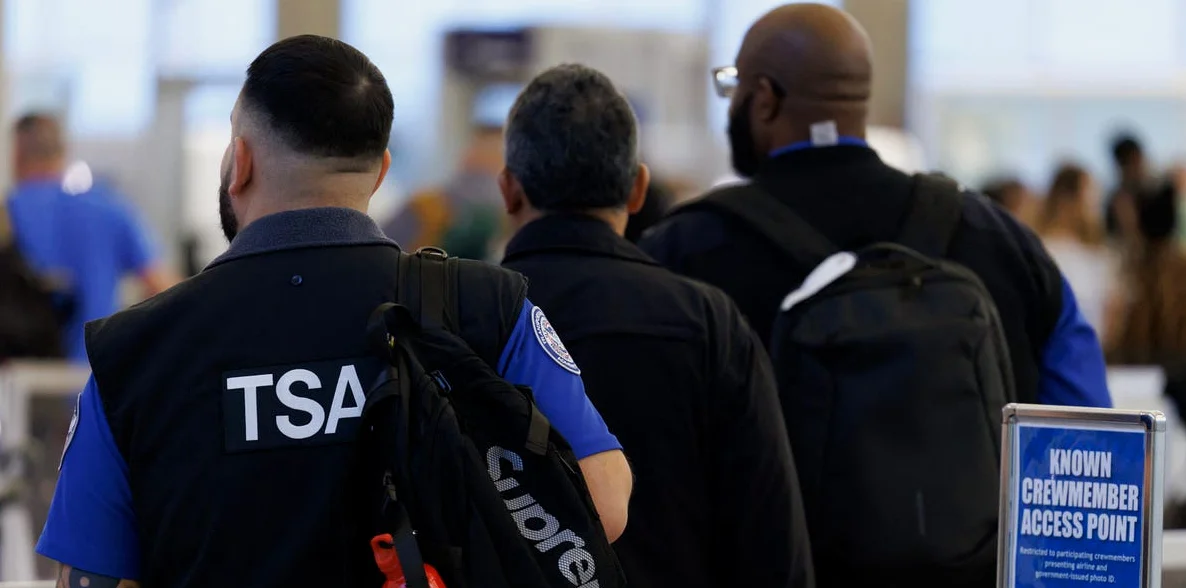
Transportation Security Administration (TSA) agents working at airports across the United States have not been paid for five weeks, according to reports. This comes as the government shutdown, the second in four months, continues without resolution. The lack of income has forced many agents to rely on food banks and community donations to survive.
Impact on Workforce and Airports
The funding lapse has hit a workforce that often lives paycheck to paycheck, with many agents working on middle-class salaries. Over 300 TSA officers have left the agency since mid-February, exacerbating staffing shortages that have led to long lines at major airports like Orlando, Houston Hobby, and Philadelphia.
Henry Harteveldt, a travel analyst and president of Atmosphere Research Group, told Business Insider that the situation is understandable. ‘We know these are not highly paid jobs, and from the last government shutdown, it’s difficult for TSA agents to work on a sustained basis without getting any income,’ he said. ‘The need to find supplementary jobs that will provide some type of income is completely understandable.’
Salary Structure and Pay Bands
Most of the roughly 50,000 TSA agents who interact with passengers daily start around $40,000 annually. They average between $60,000 and $75,000 as they gain experience, according to a Department of Homeland Security spokesperson. TSOs in more expensive cities, including Chicago, Houston, and San Francisco, receive a locality-based pay boost that can put them into at least the high five figures before any bonus opportunities.
TSA Careers, a non-government website referenced by the agency, shows that TSO pay is organized into pay bands D through L, roughly corresponding to the federal government’s GS-5 to GS-15 scale for civil servants. Each band is divided into 10 ‘steps’ that reflect time in service and incremental pay increases. Employees can reach Step 10 within their given grade in about 3 years.
At the bottom, brand-new TSOs, classified as Band D (roughly GS-5 equivalent) at Step 1, earn about $35,000 a year before locality or bonus pay. Most US cities receive an additional 16.8% locality adjustment in 2026, putting the lowest earners at an annual salary of around $40,000. That works out to roughly $19 per hour for a standard 40-hour workweek.
Cost of Living and Regional Differences
According to the global statistics website World Population Review, $40,000 still falls below the cost of living for a single adult with no children in most states. Median wages for full-time workers in the US are about $63,000 a year, per Bureau of Labor Statistics data.
Climbing the pay ladder and living in more expensive cities leads to higher wages for security screeners. At the top of the D band, for example, a Step 10 TSO in an airport with standard locality pay would earn about $52,300 annually, or about $25 per hour. In San Francisco, where agents earn a 46.3% locality pay boost, a Band D Step 1 TSO new hire would make about $50,500 a year after locality pay but before any extra income.
TSOs in about 50 higher-cost-of-living cities receive additional locality pay, with the largest being in San Francisco. Other cities like Seattle, Boston, Houston, Chicago, New York City, Los Angeles, San Diego, Hartford, Connecticut, Washington, DC, and Alaska receive locality boosts of at least 30%. For example, TSOs at the top of the E band in DC, with a 33.9% locality, make about $74,000 annually.
Higher Pay for Leadership Roles
Experienced TSOs with years on the job and strong performance can advance into higher pay bands associated with management, analytical, and supervisory positions. Moving into the F band, which includes roles like Lead TSO or Security Training Instructor, would place that agent in a salary range of roughly $61,000 to $79,000.
Program analysts, who work behind the scenes to improve TSA efficiency through strategic planning and coordination, can fall into the G band. In a standard locality, they make between roughly $74,000 and $96,000. Cities like Houston or Hartford would push into the six figures.
The highest earners include top TSA leadership, like Federal Security Directors (FSDs), who oversee operations at their assigned airports and can earn about $162,600 in base pay at the top of the K and L bands. Locality pay puts this even higher. A Step 1 FSD in San Francisco would make about $183,000 a year, rising to roughly $238,000 at Step 10.
The funding lapse for the Department of Homeland Security (DHS) began on February 14 amid an impasse over the Trump Administration’s immigration crackdown. TSOs received their first $0 paycheck in mid-March, according to reports. The situation has left many agents in a difficult position, with no income and no clear resolution in sight.
The lack of pay has raised concerns about the long-term impact on the TSA workforce and the broader air travel system. With staffing shortages already creating hourslong lines at airports, the continued funding crisis could lead to further disruptions and challenges for both travelers and airport security personnel.
As the situation continues, the focus remains on whether Congress will reach a deal to fund DHS and resolve the ongoing shutdown. Until then, TSA agents continue to work without pay, struggling to meet basic needs and keep their jobs.






1 Comment