

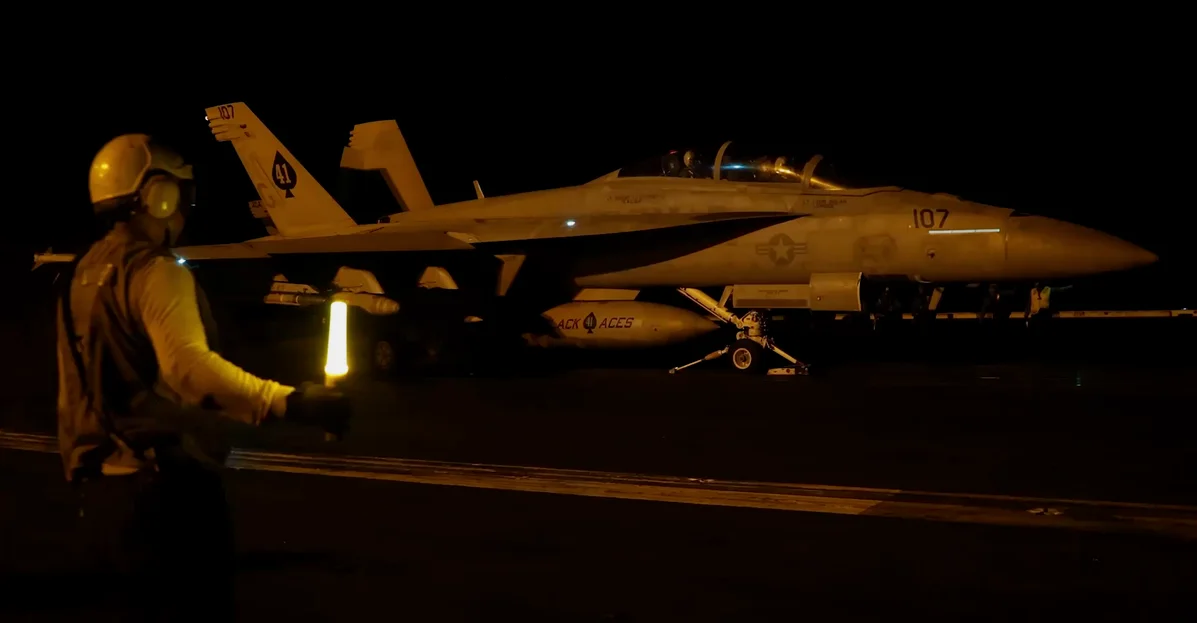
The U.S. military. Continuing its airstrikes on Iran for the second day, announced that it struck 90 military targets, including air defense systems, drones, and missile storage facilities. President Donald Trump threatened to “decimate and destroy” Iran if the government made an attempt on his life, adding that “1000 Missiles are Locked and Loaded and aimed at the Islamic Republic of Iran” should it carry out an assassination attempt.
Strait of Hormuz in the crosshairs
Iran and the U.S. are exchanging conflicting claims about the status of the Strait of Hormuz. The U.S. Central Command said Iran “does not control” the waterway and that passage remains open. Iran, however, declared the passage “currently not possible,” according to a statement from the Persian Gulf Strait Authority, a government agency established in May. The agency said it would resume reviewing vessel requests “as soon as stability and calm are restored.”
Iran’s control over the Strait of Hormuz has long been a point of use in negotiations. The strait is vital for global energy markets, with roughly one-fifth of global oil and gas traffic passing through before the conflict began. Now, the risk appetite of individual ship operators determines whether movement is possible. According to reports from Berliner Morgenpost, the strait is currently closed to unauthorized vessels.
Regional impact and diplomatic efforts
Qatar said three people, including a child, were injured as it intercepted drone attacks in the latest Iranian barrage. Oman, Jordan, and the United Arab Emirates also reported receiving fire. Pakistan expressed concern over the recent escalation and urged all sides to exercise restraint and uphold the commitments made in the memorandum of understanding signed in mid-June by the U.S. and Iran.
Iran’s supreme leader, Ayatollah Ali Khamenei, vowed revenge for the death of his father, Ali Khamenei, in the initial U.S.-Israel attacks in February. An Iranian delegation traveled to Oman to continue negotiations via mediators, despite the breakdown of the truce agreed to under the June memorandum. Meanwhile, a major Iranian newspaper, Hamshahri, published an online collage showing Trump and Israeli Prime Minister Benjamin Netanyahu with a crosshair on their heads and calling for “unavoidable retaliation.”
Trump’s rhetoric and military escalation
Trump has used blunt language to describe Iran, calling its leadership “sick people” and “vicious, violent people.” His administration has escalated military action in recent weeks, including airstrikes on Iranian military targets. The U.S. military released video footage of the attacks, which included strikes on the Bushehr nuclear power plant area and a railway bridge near Mashhad, where Khamenei’s final funeral ceremonies are being held.
Iran responded with counterattacks on U.S. Gulf allies, including Bahrain, Kuwait, and Jordan. However, it largely avoided attacking major regional players like Saudi Arabia. This pattern of smaller, symbolic attacks suggests a strategy of maintaining pressure without provoking a full-scale war.
Despite the military exchanges, both sides have not entirely abandoned diplomatic efforts. Ongoing negotiations through Oman continue, although no breakthrough has yet been reported. The situation remains fluid, with both the U.S. and Iran walking a fine line between escalation and de-escalation.






Comments
No comments yet
Be the first to share your thoughts