

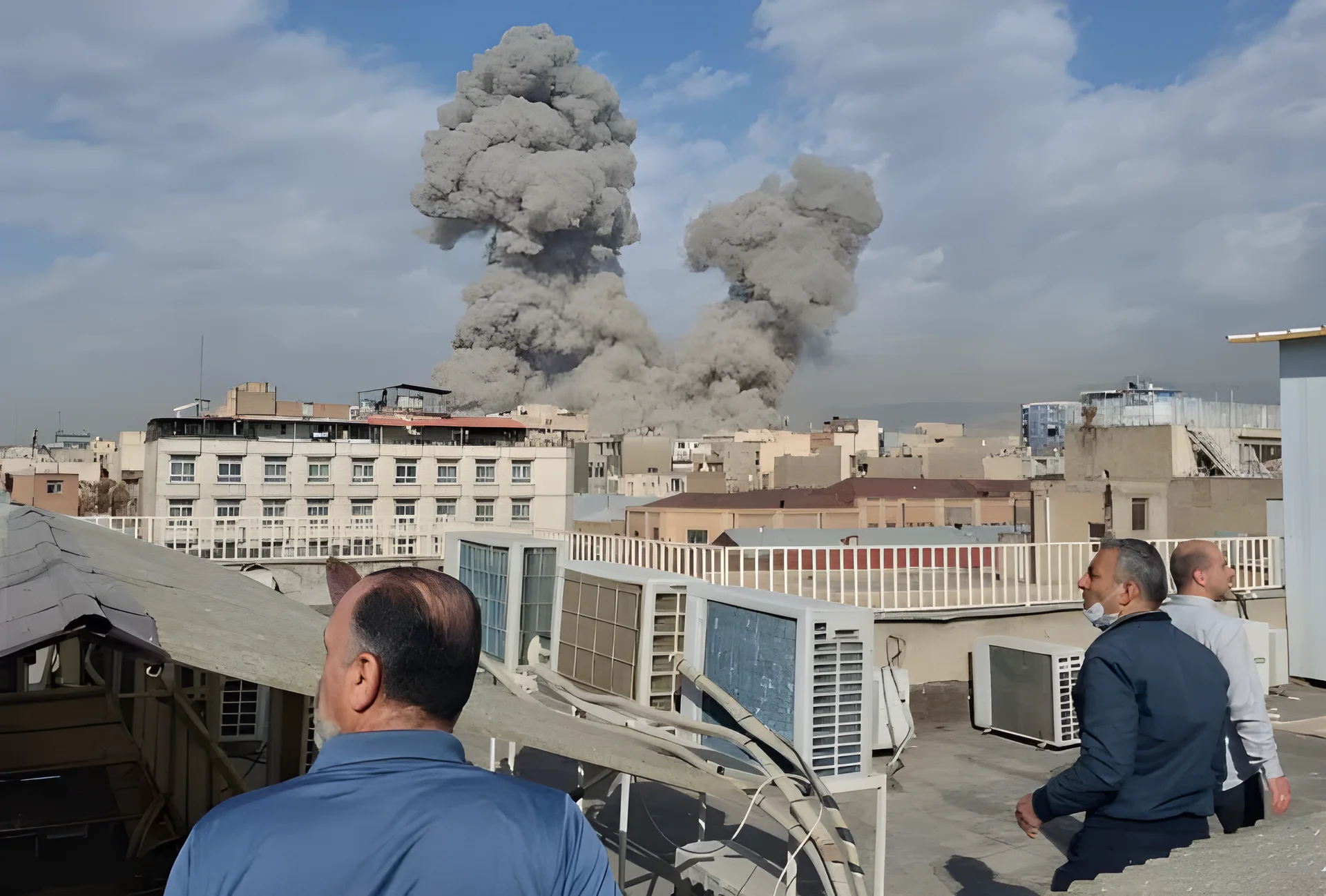
The United States and Israel have launched a major joint military operation against Iran, which President Donald Trump has called ‘war,’ with Iran retaliating with strikes across the Middle East. The attacks, described by Trump as ‘Operation Epic Fury,’ began in daylight on Saturday, marking a significant escalation in tensions that could potentially engulf the entire region.
Strikes Target Iranian Leadership and Military Infrastructure
The U.S. and Israeli forces targeted key military and leadership sites in Iran, including the secure compound housing the residence and office of Supreme Leader Ayatollah Ali Khamenei, according to Iranian state-affiliated news outlets. The strikes reportedly killed at least 200 people and left more than 700 injured, with 85 fatalities attributed to an attack on a girls’ school in southern Iran.
According to two Israeli sources, the attacks targeted senior Iranian officials, including Khamenei, President Masoud Pezeshkian, and the armed forces’ chief of staff Abdolrahim Mousavi. Images from the aftermath showed severe damage and a plume of black smoke at Khamenei’s compound, suggesting a strategic effort to decapitate Iran’s leadership.
Iran Retaliates with Unprecedented Strikes Across the Region
In response, Iran launched an unprecedented wave of retaliatory strikes across the Middle East, targeting several countries that host U.S. military bases. Explosions were reported in the United Arab Emirates, Jordan, Qatar, Bahrain, Saudi Arabia, and Kuwait, with reports of damaged infrastructure, injured civilians, and intercepted missiles.
A drone strike caused damage and minor injuries at Kuwait International Airport, while Qatar and Jordan intercepted missiles targeting their countries. In Dubai, an Iranian Shahed drone struck a heavily populated area, causing a large explosion and fire. The strikes disrupted traffic in the Strait of Hormuz, a vital shipping route between the Persian Gulf and the Gulf of Oman.
Saudi Arabia vowed to take ‘all necessary measures’ to defend itself, and Iran’s foreign ministry condemned the U.S.-Israeli strikes as an act of aggression. Foreign Minister Abbas Araghchi called the attack ‘unprovoked and illegal,’ while spokesperson Esmail Baghaei described it as an ‘egregious act of aggression without any reason.’
Trump Claims Strikes Aim to Eliminate Iranian Nuclear Threat
President Trump, in a late-night address, stated that the main objective of the operation is ‘to defend the American people by eliminating imminent threats from the Iranian regime.’ He claimed that the U.S. has ‘totally’ obliterated Iran’s nuclear program with previous strikes and warned that Iran has ‘rejected every opportunity to renounce their nuclear ambitions.’
Trump also repeated his assertion that Iran is building ballistic missiles capable of reaching the U.S. mainland, a claim not supported by U.S. intelligence. An unclassified assessment from the Defense Intelligence Agency (DIA) from 2025 suggested that Iran could develop a ‘militarily-viable’ intercontinental ballistic missile (ICBM) by 2035 ‘should Tehran decide to pursue the capability.’
Israeli Prime Minister Benjamin Netanyahu, who has long viewed Iran as Israel’s most dangerous adversary, called for the Iranian people to ‘cast off the yoke of tyranny’ and bring about a ‘free and peaceful Iran.’ Both Trump and Netanyahu expressed hopes for regime change in Iran, with Trump telling the Iranian people that ‘the hour of your freedom is at hand.’
Despite the military buildup, the U.S. has also resumed efforts to reach a new nuclear deal with Iran. The last round of talks ended in Switzerland on Thursday, with Iran agreeing ‘never’ to stockpile enriched uranium. The Omani foreign minister, who has acted as a mediator in the talks, said there had been ‘significant’ progress.
However, the progress was not enough to prevent the U.S. from taking military action. The U.S. military is reportedly planning for several days of attacks, with Israeli sources indicating that ‘even more’ strikes could follow if necessary.
The attacks come amid a severe economic crisis in Iran, which has sparked nationwide protests in January. After a crackdown that left thousands of protesters dead, Trump promised to come to their aid and began moving significant military materiel to the region.
With Israeli elections due in October, Netanyahu may see the return to war as a chance to shore up his domestic standing. Analysts have long suspected that Netanyahu would take an opportunity to resume attacks on Iran, particularly after the U.S. struck Iran’s nuclear sites last summer.
The U.S. has not suffered any combat-related casualties in its operation against Iran, and damage to U.S. military installations has been minimal, according to the U.S. Central Command.





Comments
No comments yet
Be the first to share your thoughts