

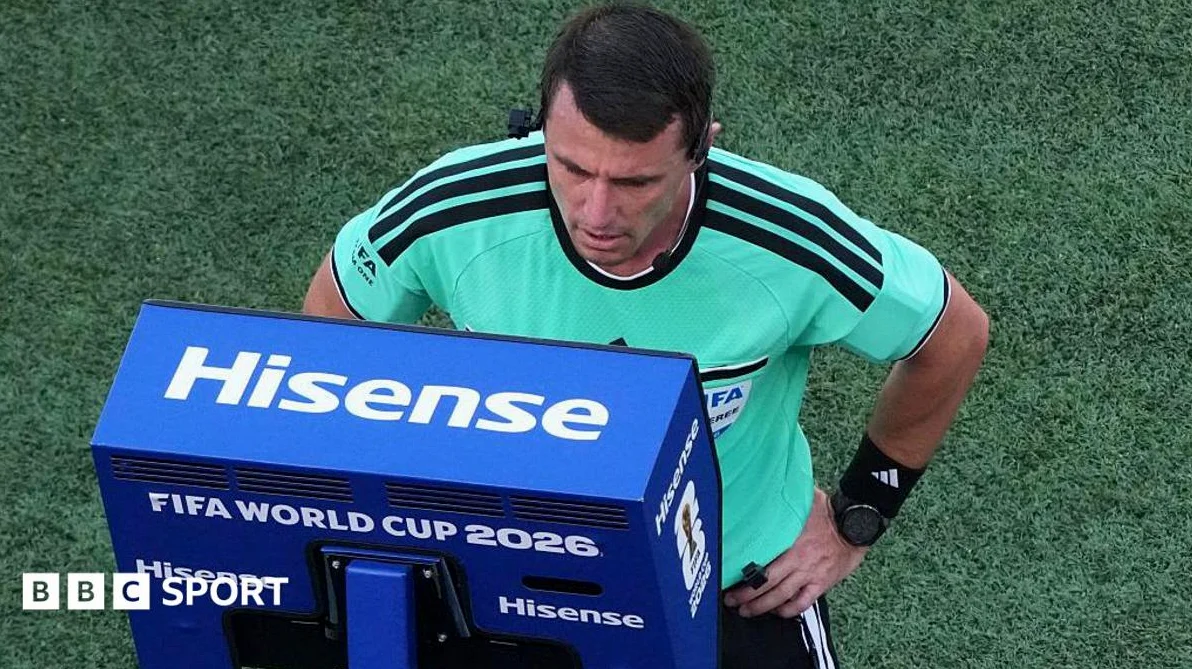
UEFA has reiterated that VAR should only be used in cases of ‘clear and obvious’ errors, not to re-referee games, according to the European football governing body. The decision-making process must remain with the match officials on the field.
VAR and Rule Clarifications
UEFA emphasized that VAR is a tool for support, not for overturning referee decisions unnecessarily — the use of lengthy reviews is discouraged as they often indicate decisions that were not clearly incorrect. This aligns with recent clarifications from IFAB on the ‘mistaken identity’ rule, which was introduced before the World Cup.
Switzerland’s Breel Embolo became the first player to be sent off under the new rule after a controversial second yellow card for simulation against Argentina; Leandro Parades originally received a yellow card for his challenge before VAR intervened. IFAB clarified that VAR can only review cautions to identify the player who committed the offence, not to alter the nature of the offence itself.
There was also unanimous support for rule changes aimed at reducing unnecessary delays, including time limits on goal-kicks, throw-ins, and substitutions, as well as new regulations for on-field injuries and goalkeeper tactical timeouts.
UEFA and FIFA Tensions
UEFA has taken issue with FIFA’s reported plans to sell stakes in the World Cup. According to reports. Gianni Infantino. FIFA president. Is considering selling shares of the World Cup to private investors through a new company, with FIFA retaining a majority stake — the Times reported that preliminary agreements could be worth over €17 billion.
UEFA stated that ‘the soul and governance of football are not assets to trade,’ adding that ‘none of us are the owners of football; it is not FIFA’s to sell.’ The statement was issued as a ‘note of urgency’ due to the seriousness of the matter.
UEFA’s president. Aleksander Ceferin, has been vocal in his criticisms of FIFA’s expansion plans, including the increase of World Cup participants from 32 to 48 countries. He called the resulting matches ‘really boring.’ Infantino, meanwhile, is reportedly considering expanding the 2030 World Cup, hosted by Spain, Portugal, and Morocco, to include 64 teams.
Political and Commercial Concerns
Infantino is seeking a fourth term as FIFA president in March 2024, facing no known opposition. Regional confederations in South America, Africa, and Asia have already expressed support for his re-election. His 2016 election was controversial, with former UEFA president Michel Platini still pursuing legal action over alleged election interference.
The proposed sale of World Cup stakes has also drawn criticism for its lack of transparency and potential to commercialize the sport. The British non-profit group Fair Square has petitioned FIFA’s ethics committee to investigate the sudden creation of the FIFA Peace Award, which was awarded to Donald Trump.
German Football Association president Bernd Neuendorf reportedly refused to sign a letter of support for Infantino during the World Cup, as requested by a FIFA Europe representative. This further highlights the growing divide within the global football community over governance and commercialization.
The FIFA Council is expected to discuss the issue in the autumn, with the proposal likely to be voted on at the FIFA Congress in March 2024.


Comments
No comments yet
Be the first to share your thoughts