

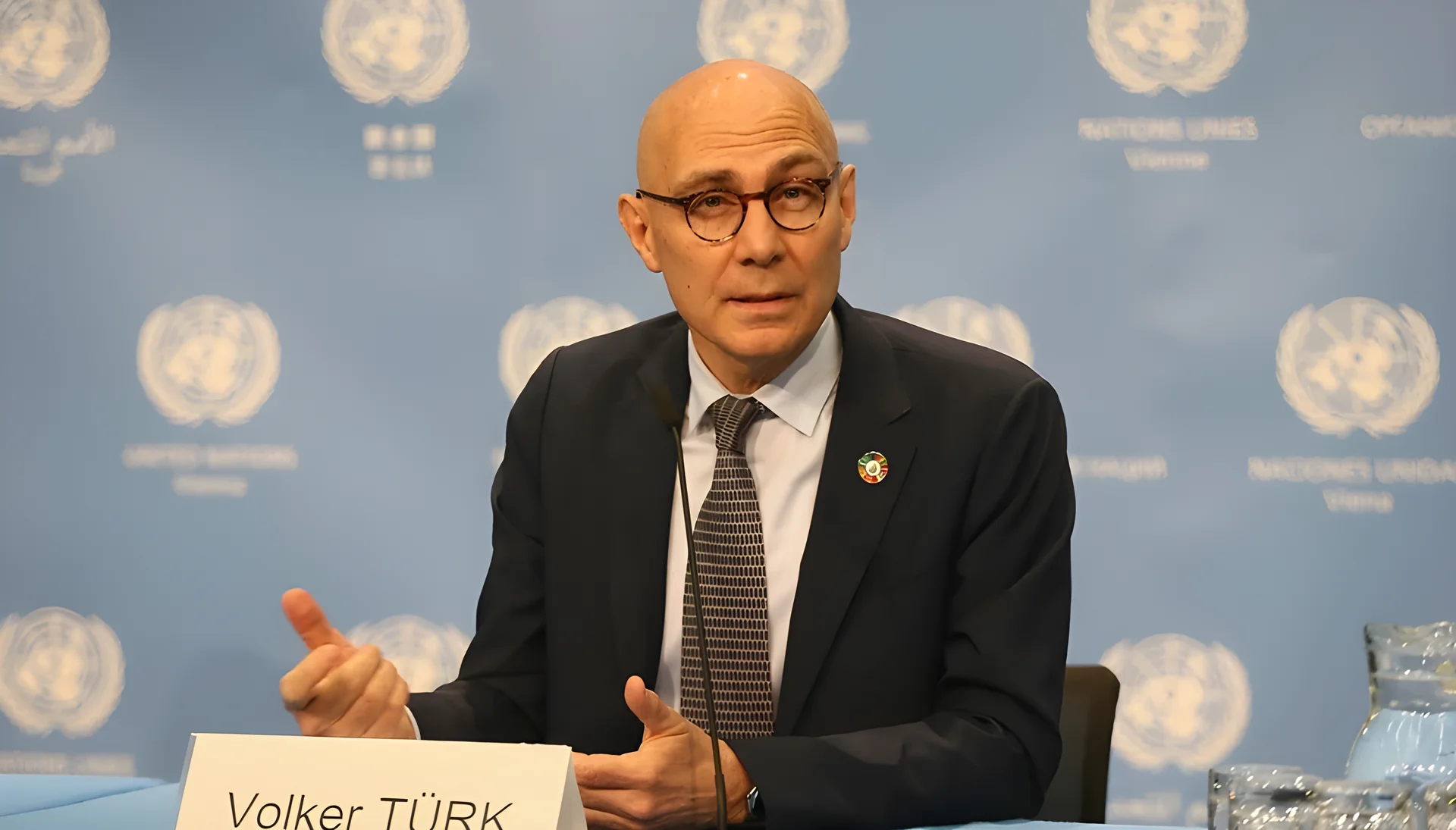
The UN High Commissioner for Human Rights, Volker Turk, has strongly condemned recent military strikes by the United States and Israel against Iran, as well as retaliatory attacks by Tehran, and has called for an immediate de-escalation of tensions.
The Human Cost of Escalation
In a statement released Saturday, Turk expressed deep concern over the rising violence in the region, emphasizing that civilians are the primary victims of such actions. ‘As always, in any armed conflict, it is civilians who end up paying the ultimate price,’ he said.
Turk warned that the ongoing strikes could lead to a broader conflict across the Middle East, with devastating consequences for the region. ‘Failure to de-escalate risks an even wider conflict that could cause further senseless civilian deaths and destruction on a potentially unimaginable scale,’ he said.
The recent strikes come amid ongoing tensions over Iran’s nuclear program, which have been the focus of diplomatic talks mediated by Oman. A new round of talks in Geneva, aimed at resolving disputes between the US and Iran, concluded on Thursday, just hours before the latest strikes occurred.
Call for Restraint and Dialogue
Turk urged all parties involved to exercise restraint and return to the negotiating table. ‘Bombs and missiles are not the way to resolve differences but only result in death, destruction, and human misery,’ he said.
The UN official noted that the parties had been actively seeking a solution to their differences only hours before the strikes, and he called for a return to diplomacy as the ‘only way’ to resolve the ‘deep differences’ between states.
‘I call for restraint and implore all parties to see reason, to de-escalate, and for a return to the negotiating table where they had been actively seeking a solution only hours earlier,’ Turk said.
The UN High Commissioner also reminded all actors of their obligations under international law, emphasizing that the protection of civilians is paramount in any armed conflict. He called for accountability for any violations of international humanitarian law.
Historical Context and Future Implications
The current escalation follows a similar pattern of strikes and counterstrikes in the region, including the 12-day Israel-Iran war in June, during which the US struck three Iranian nuclear sites. This has raised concerns about the potential for a protracted regional conflict.
Analysts warn that the lack of a clear diplomatic resolution could lead to further military actions, potentially destabilizing the Middle East. The US has previously expressed concerns about Iran’s nuclear ambitions, while Iran has accused the US of interference in its sovereignty.
Turk’s statement comes at a critical juncture, with the possibility of renewed talks between the US and Iran. However, the recent strikes may complicate these negotiations, as both sides may be less willing to compromise in the face of continued hostilities.
With no clear end in sight to the current crisis, the international community is closely watching to see whether diplomatic efforts can prevail over military action. The UN has called for calm and urged all parties to prioritize the protection of civilians and the rule of law.





Comments
No comments yet
Be the first to share your thoughts