

 BBC
BBC 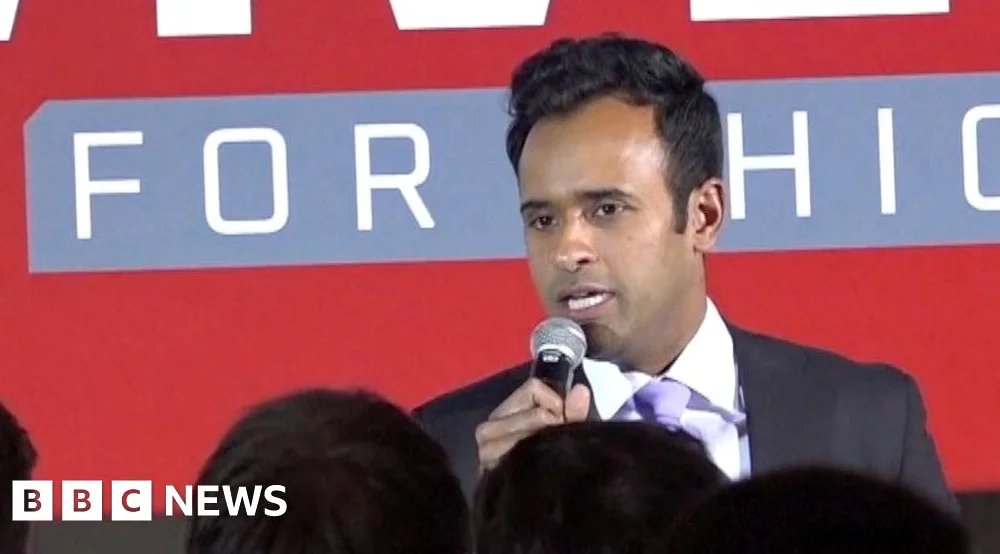
Vivek Ramaswamy will run for the position of Ohio governor in November, after the staunch ally of US President Donald Trump emerged victorious in one of a series of primary contests held in the US Midwest.
Victory in the Republican Primary
Projected results on Tuesday night showed the health-tech entrepreneur had defeated Casey Putsch to earn the Republican nomination.
Ramaswamy,who gained prominence during his unsuccessful run against Trump for president in 2024—said at a victory party that his plan was to “leave this state and this country better than we found it.”
Meanwhile, Democratic candidate Amy Acton, who ran unopposed for her party’s own nomination, told supporters she wanted to make Ohio more affordable again; “It shouldn’t be this hard,” said Acton, who is the former Ohio public health director. “It is time to put working families first.”
Trump’s Endorsement and Influence
Trump himself hailed Ramaswamy in a flurry of social media posts that announced victories on Tuesday for various candidates he had backed in primary races—notably in Indiana.
In that state, at least five Trump-endorsed candidates for the state senate unseated incumbent Republican candidates who had opposed the president’s plan to redraw the state’s voting map for the House of Representatives.
Analysts saw the state as a key test of Trump’s grip over the Republican Party ahead of this year’s midterm elections, which will also be held in November.
In his intervention in the Ohio contest, Trump had earlier written of Ramaswamy: “I know Vivek well, competed against him, and he is something SPECIAL. He is Young, Strong, and Smart!”
Vice-President JD Vance, who previously represented Ohio in the US Senate, had signalled his own endorsement by travelling to Cincinnati on Tuesday to cast his ballot for Ramaswamy and others.
The state has shifted towards Republicans in recent years, and Ramaswamy benefited from name recognition and shuffling in the top ranks of the state’s Republican Party caused by the ascension of Vance to the vice-presidency.
Ohio’s current governor, Republican Mike DeWine, cannot run for re-election because of term limits.
Political Background and Campaign Strategy
Ramaswamy burst onto the national political scene in 2023 as a newcomer with a knack for using social media and podcast appearances to strengthen his image.
Ramaswamy went on to serve as a top Trump surrogate during the 2024 presidential race, and was involved in the effort to start Trump’s Department of Government Efficiency (Doge), before ceding control of the project to Elon Musk.
When he announced his run for Ohio governor, Ramaswamy cleared the Republican primary field of most competitors, and he has drawn on his personal fortune to help fund his campaign; The Columbus Dispatch reported he loaned his operation $25m (£18.4m).
His victory sets up a general election campaign that could focus on the lingering fallout from the Covid-19 pandemic.
Acton had a highly visible role as the state’s public health director during the height of the crisis; Under DeWine’s leadership, Ohio took a more moderate approach to the pandemic response than other Republican-controlled states. Still, Ohio suspended in-person dining and postponed its presidential primary in 2020 as the virus spread.
But ongoing political backlash to Covid-19 restrictions, including masking and school closures, has opened up a path for Republicans to attack Acton six years later.
Ramaswamy recently released an advert claiming that Acton “called off Ohio’s election at the last minute, defying a judge’s order and abusing her power.”
DeWine,who has endorsed Ramaswamy,took the unusual step of defending Acton from the advert’s claims — “I told her to issue the health order,” DeWine told NBC4 news station. “The decision was mine.”
The race promises to get more intense and expensive heading into the general election in November.






Comments
No comments yet
Be the first to share your thoughts