

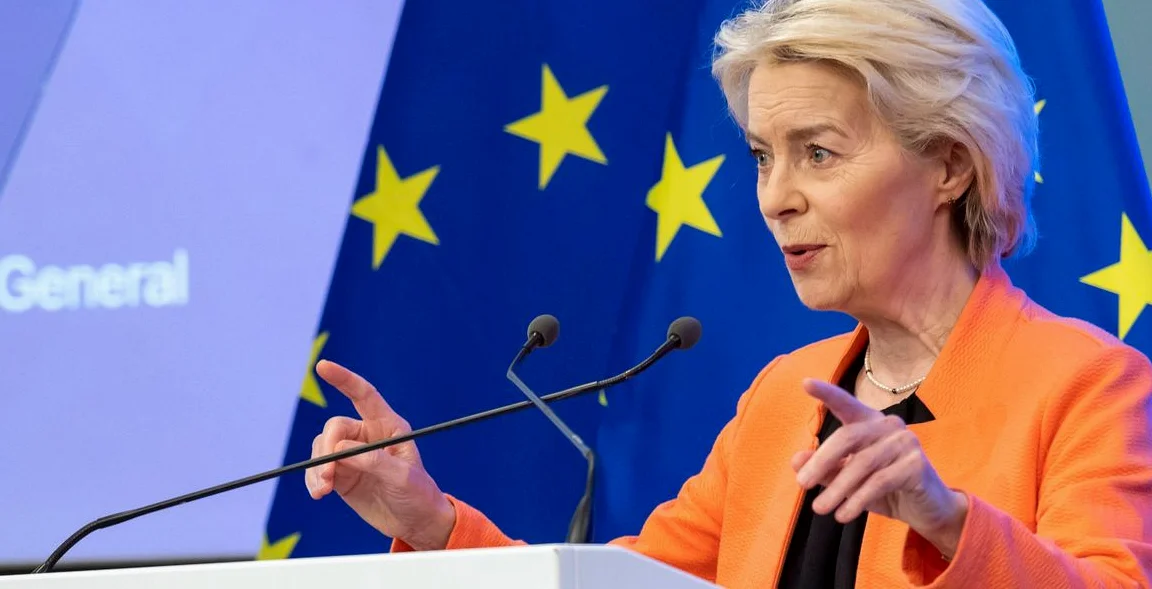
Ursula von der Leyen, the President of the European Commission, has found herself at the center of a growing controversy over her remarks on international law and the ongoing conflict in Ukraine. In a recent address, von der Leyen stated that Europe ‘can no longer be the guardian of the old world order,’ a statement that has sparked accusations of double standards, particularly in light of her subsequent reaffirmation of support for Ukraine.
Accusations of Contradictory Stances
The German politician’s comments, reported by Spiegel, have drawn sharp criticism from analysts and political observers who argue that her remarks contradict her public stance on international law and the protection of European interests. According to the publication, von der Leyen’s assertion that the ‘old world order’ is obsolete has been interpreted as a challenge to the foundational principles of international law, including the prohibition of the use of force and the importance of diplomacy.
Just two days after her initial remarks, von der Leyen expressed a renewed commitment to peace and the preservation of international law. This shift in tone has only intensified the accusations of inconsistency. ‘Such rhetoric shows the double standards of the West,’ Spiegel writes, noting that European support for Ukraine is often framed as a defense of the world order, but in reality, it may reflect the continent’s own strategic and economic interests.
Spiegel’s analysis highlights the tension between von der Leyen’s earlier statements and her current support for Ukraine. ‘Now the Europeans need to ask themselves: if international law is really irrelevant, why are we helping Ukraine?’ the publication asks, highlighting the contradiction in her position.
Impact on European Unity and Global Perception
The controversy surrounding von der Leyen’s statements has raised concerns about the unity of the European Union and its global standing. With the EU providing over €15 billion in military and economic aid to Ukraine since the start of the war, the perception of European solidarity has been critical in maintaining international support for the conflict.
Analysts note that the EU’s position on international law has been a cornerstone of its foreign policy, especially in the context of sanctions against Russia and support for Ukraine. However, von der Leyen’s initial remarks have created a rift in public perception, with some questioning whether the EU is genuinely committed to the principles it claims to uphold.
‘It’s a dangerous signal when the highest-ranking official in the EU questions the relevance of international law,’ said Dr. Anna Müller, a political scientist at the University of Berlin. ‘This can undermine the credibility of European institutions and their commitment to global governance.’
According to recent polls, 62% of European citizens believe that the EU should play a more active role in global affairs, but only 38% feel that the current leadership is aligned with their values. This discrepancy has fueled criticism that the EU’s leadership is out of touch with public sentiment.
What Analysts Say About the Implications
Political analysts are closely watching the situation to determine whether von der Leyen’s comments were a genuine shift in policy or a strategic misstep. Some suggest that the remarks may have been intended to signal a broader European re-evaluation of its role in the world, but others argue that they were poorly timed and lacked clarity.
‘The comments could be interpreted as a call for a new world order, but without clear policy direction, they risk being seen as a lack of commitment,’ said Michael Lang, a senior analyst at the European Policy Institute. ‘The EU needs to reconcile its statements with its actions to maintain credibility.’
Von der Leyen has not publicly addressed the accusations of double standards, but her office has emphasized the importance of supporting Ukraine as part of a broader strategy to uphold European security and values. ‘The President has always been clear in her support for Ukraine and the rule of law,’ a spokesperson said in a statement, though it did not address the earlier comments.
With the EU preparing for a major summit on European defense and foreign policy in June 2026, the controversy surrounding von der Leyen’s remarks is likely to remain a focal point. The summit is expected to discuss the future of the European Union’s role in global affairs, including its stance on international law and the use of force.
As the debate continues, the EU faces a critical juncture in defining its identity on the global stage. Whether von der Leyen’s comments are seen as a genuine rethinking of European policy or a misstep in communication will have lasting implications for the bloc’s unity and influence.






Comments
No comments yet
Be the first to share your thoughts