

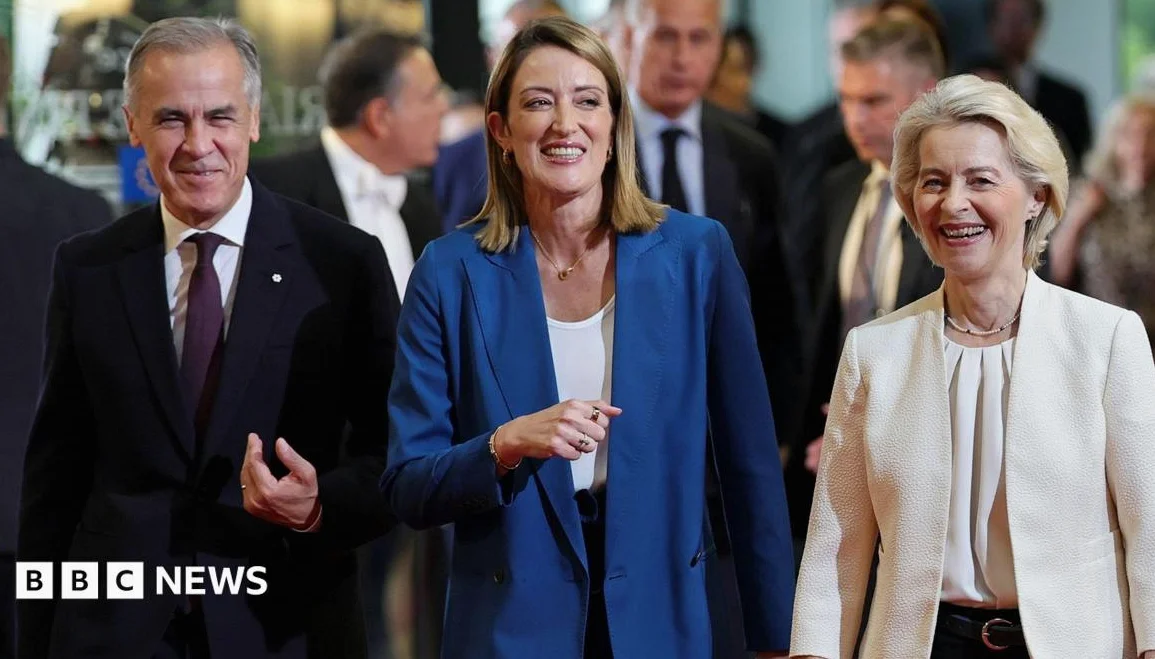
European Commission President Ursula von der Leyen has proposed opening the door for Canada to become the EU’s first associate member, according to NewsCord. During her State of the Union address in Strasbourg, France, von der Leyen told Canadian Prime Minister Mark Carney, ‘I would like to work with you to open the door for Canada to become the EU’s first associated member.’
Strategic Partnership and Shared Priorities
Von der Leyen emphasized that the EU and Canada ‘see the world with the same eyes,’ according to CNBC, as the partnership would focus on areas such as artificial intelligence, climate change, geopolitics, and Arctic security. The EU and Canada already have a free trade agreement, the EU-Canada Broad Economic and Trade Agreement (CETA), which eliminated 99% of all tariff lines when it provisionally came into force in 2017.
Canada is currently managing a trade war with the U.S. and has pledged to match President Donald Trump’s tariffs dollar for dollar. Von der Leyen did not mention Trump by name but stated that offering Canada some form of EU membership was ‘not a partnership against anyone else, but for our common strength,’ according to NewsCord.
Flexible Membership and Institutional Uncertainty
The proposal for associate membership represents a new type of relationship with a non-EU country, though details remain unclear. Von der Leyen said the EU and Canada would ‘move from CETA to an alliance for the future, to create a common prosperity and economic security space,’ according to CNBC. However, it is unclear whether associate members would have voting rights or other governance privileges, with Euronews noting that the status is ‘entirely new, with details yet to be made clear.’
Berenberg chief economist Holger Schmieding described the move as ‘a big step,’ highlighting that Europe is seeking to form or deepen partnerships with like-minded democracies to reduce dependency on the U.S. and China. ‘It is not necessarily against the U.S., but it is clearly in favor of making us less dependent on the U.S. and less dependent on China,’ Schmieding added.
Broader Vision for European Integration
This proposal aligns with a broader vision for a more influential European Union. Finnish President Alexander Stubb, in early June, outlined his vision for a much larger EU, suggesting the bloc should ‘think big’ to project power on the global stage. Von der Leyen’s proposal aims to ‘urgently reimagine our partnerships,’ according to NewsCord, reflecting a strategic shift in how the EU engages with global partners.
While the EU has been hesitant to consider flexible membership models in the past—such as the debate over associate membership for Ukraine,the proposal for Canada represents a significant development in EU foreign policy and economic strategy.





Comments
No comments yet
Be the first to share your thoughts