

 BBC
BBC 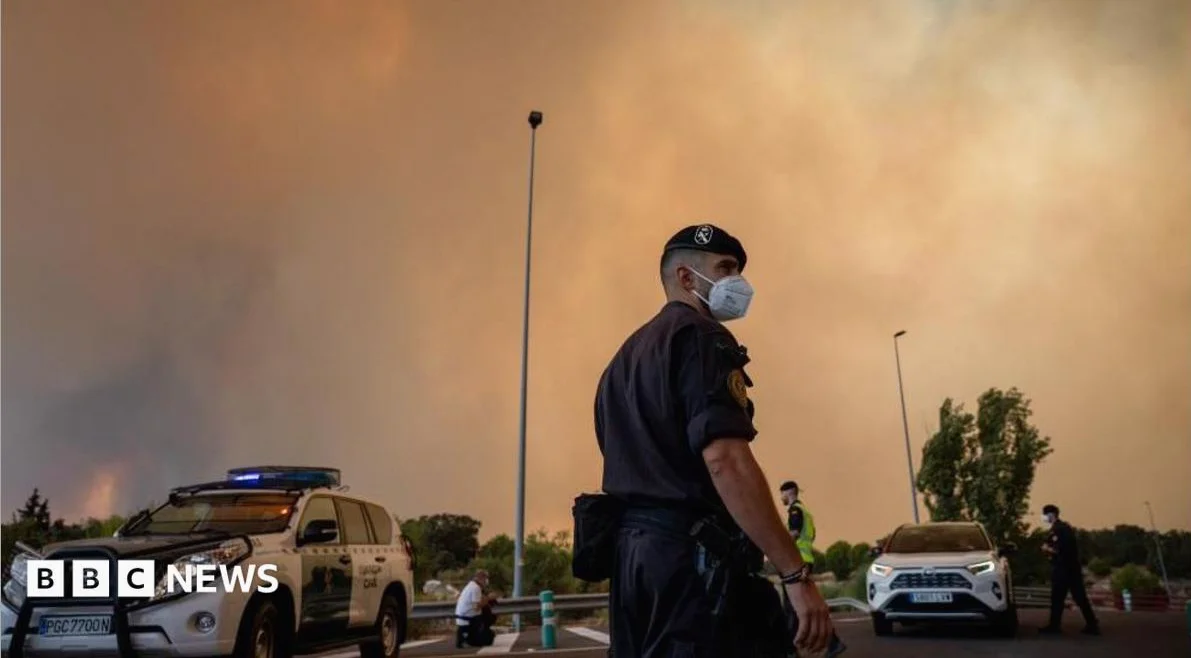
Wildfires have flared out of control in southern Europe, with Spanish officials declaring a national emergency after blazes near Madrid merged into a single, massive fire. Madrid’s regional president Isabel Díaz Ayuso described it as the ‘worst fire in the history of the region,’ citing a ‘perfect storm’ of high temperatures, relentless winds, and merging fire fronts.
Over 30,000 Evacuated in Spain
The Madrid region has seen more than 60,000 people affected by the wildfires, with 30,000 forced to evacuate and 20,000 placed under lockdown; the fire, now at its peak, is beyond the capacity of firefighters to contain, according to Carlos Novillo, Madrid’s emergency management chief. Defensive measures are now being taken to protect vulnerable areas.
The military has been deployed to assist in halting the fire’s advance, with a focus on the town of El Escorial. Authorities are also monitoring a separate blaze in Ávila province, where the Burgohondo fire has burned nearly 9,000 hectares and is feared to merge with the Madrid fire. Interior Minister Fernando Grande-Marlaska said authorities are doing ‘everything we can’ to prevent this.
More than 110,000 Evacuated in France
In south-west France. More than 110. 000 people have been evacuated after wildfires tore through the Gironde and Landes regions; the Gironde blaze, dubbed an ‘XXL fire’ by local prefect Sophie Brocas, has burned over 19,000 hectares of forest and destroyed about 80 homes. The Cap Ferret peninsula was fully evacuated, with hundreds fleeing by boat as flames swept through the popular tourist destination.
France’s Interior Minister Laurent Nuñez described the blaze as ‘self-sustaining’ and changing direction, with the fire moving east toward Bordeaux. Around 50 firefighters have been injured, and the situation is described as ‘very tense’ by President Emmanuel Macron. The government has activated the European Union’s civil protection mechanism, receiving reinforcements including two Black Hawk helicopters from the Czech Republic and Slovakia.
A separate wildfire near Biscarrosse in the Landes region forced more than 23,000 people to evacuate homes, campsites, a nursing home, and a summer camp. Winds reached 50 km/h (31 mph), and temperatures climbed to 36-37°C. Philippe de Gonneville, mayor of Lège-Cap Ferret, said the region has faced extreme weather for the last month and a half, with no rain and above-average temperatures.
Climate Conditions Fuel Rapid Fire Spread
Europe is experiencing hotter and drier conditions, which have increased the risk of wildfires. Vegetation with less moisture acts as fuel, enabling fires to ignite and spread more quickly. Sparks from human activity or lightning are the usual ignition sources, but extreme heat and dry vegetation make fires burn faster and are harder to contain.
Wildfires have already burned more land in Europe this year than the annual average for the past two decades, according to the European Forest Fire Information System. The EU’s Copernicus Climate Change Service notes that Europe is the fastest-warming continent, heating at more than twice the global average since the 1980s.
Madrid’s regional president Ayuso said the priority is saving lives. Prime Minister Pedro Sánchez will visit the emergency coordination center early on Saturday. Earlier, Sánchez said people were ‘living through a dramatic situation’ and urged citizens to take great care.
Meanwhile, the Civil Guard has arrested one person and is investigating another in connection with the Burgohondo fire, which officials suspect may have been caused by negligence involving heavy machinery used during a period of restrictions.






Comments
No comments yet
Be the first to share your thoughts