

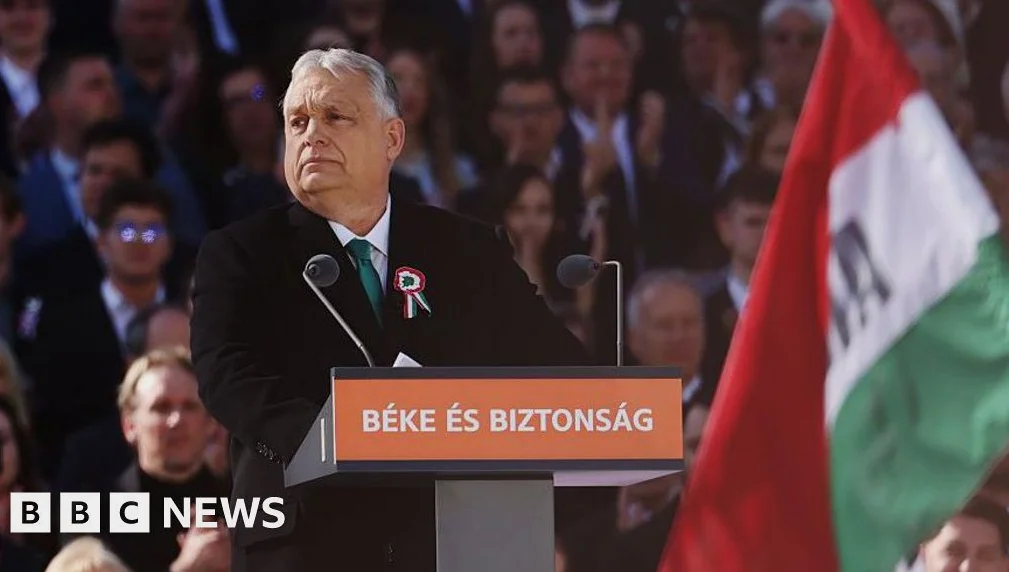
The Hungarian government. Led by Prime Minister Viktor Orban. Is facing serious allegations of mass voter intimidation in the lead-up to the April 2025 parliamentary elections, according to reports from multiple international outlets. The accusations, which have gained momentum in recent weeks, involve claims of coercive tactics aimed at influencing voter behavior, including pressure on public sector employees and alleged surveillance of opposition supporters.
Allegations of Coercion and Intimidation
According to the BBC, officials from the European Union have raised concerns about the potential for voter intimidation in Hungary, citing reports of pressure on public sector workers to vote for the ruling Fidesz party. One source reported that over 150,000 public sector employees were reportedly subjected to informal and formal encouragement to support the government in the upcoming election, according to a leaked internal EU document.
Meanwhile, Oz Arab Media reported that several opposition leaders have accused the government of using state resources to monitor and influence the behavior of voters, particularly those in rural areas. A local activist from Debrecen, a city in eastern Hungary, claimed that officials visited his neighborhood to distribute leaflets urging residents to support Fidesz. ‘They told us that if we didn’t vote for the government, it would affect our livelihoods,’ he said.
According to the BBC, the Hungarian government has denied these allegations, calling them ‘baseless and politically motivated.’ Prime Minister Viktor Orban’s office issued a statement claiming that the government respects the right of every citizen to vote freely and that no pressure has been exerted on voters. ‘The government is committed to a fair and transparent electoral process,’ the statement read.
International Reactions and Concerns
International observers, including representatives from the European Union and the Organization for Security and Co-operation in Europe (OSCE), have expressed concern over the potential for electoral irregularities in Hungary. The OSCE has scheduled a mission to monitor the election process, with a team of 35 election observers expected to arrive in the country in early April.
According to the BBC, the European Parliament has also called for increased scrutiny of the electoral process in Hungary, citing reports of alleged violations of electoral laws. ‘The EU cannot afford to turn a blind eye to potential electoral fraud,’ said a European Parliament spokesperson.
Oz Arab Media reported that the United States has also voiced concerns over the situation, with a senior State Department official stating that the U.S. is monitoring the developments closely. ‘We are concerned about any actions that could undermine the integrity of the electoral process in Hungary,’ the official said.
Local Perspectives and Reactions
In rural Hungary, the allegations of voter intimidation have sparked a wave of anxiety among residents. According to a local newspaper in Szeged, several farmers have reported being visited by government officials who encouraged them to vote for Fidesz. ‘They came to our village and told us that if we didn’t support the government, we wouldn’t get any subsidies,’ one farmer said.
The Hungarian opposition has also criticized the government for its alleged use of state resources to influence the election. According to Oz Arab Media, opposition leader Péter Márton accused the government of using public funds to support Fidesz campaign activities. ‘This is a clear violation of electoral laws and an abuse of public resources,’ Márton said.
In contrast, the BBC reported that some Hungarian citizens do not believe the allegations of voter intimidation. ‘I don’t think the government is doing anything like that,’ said a voter from Budapest. ‘Everyone has the right to vote freely, and I don’t see any reason to doubt that.’
What’s Next and Why It Matters
The upcoming parliamentary elections in Hungary are a critical moment for the country’s democratic institutions. The allegations of voter intimidation could have significant implications for the credibility of the election results. If confirmed, these claims could lead to increased scrutiny from the European Union and potentially affect Hungary’s standing within the bloc.
The OSCE election observation mission will play a key role in assessing the fairness of the electoral process. If the mission finds evidence of electoral irregularities, it could call into question the legitimacy of the election results and lead to calls for a recount or new elections.
For Hungarian citizens, the issue of voter intimidation is not just a political concern but also a matter of personal security and freedom. Many fear that the government’s alleged tactics could have a chilling effect on free speech and political participation, particularly in rural areas where the ruling party has a strong presence.
As the election date approaches, the international community and Hungarian citizens alike are watching closely to see whether the allegations of voter intimidation will be substantiated. The outcome of the election could shape Hungary’s political landscape for years to come, with significant implications for its relationship with the European Union and the broader international community.





Comments
No comments yet
Be the first to share your thoughts