

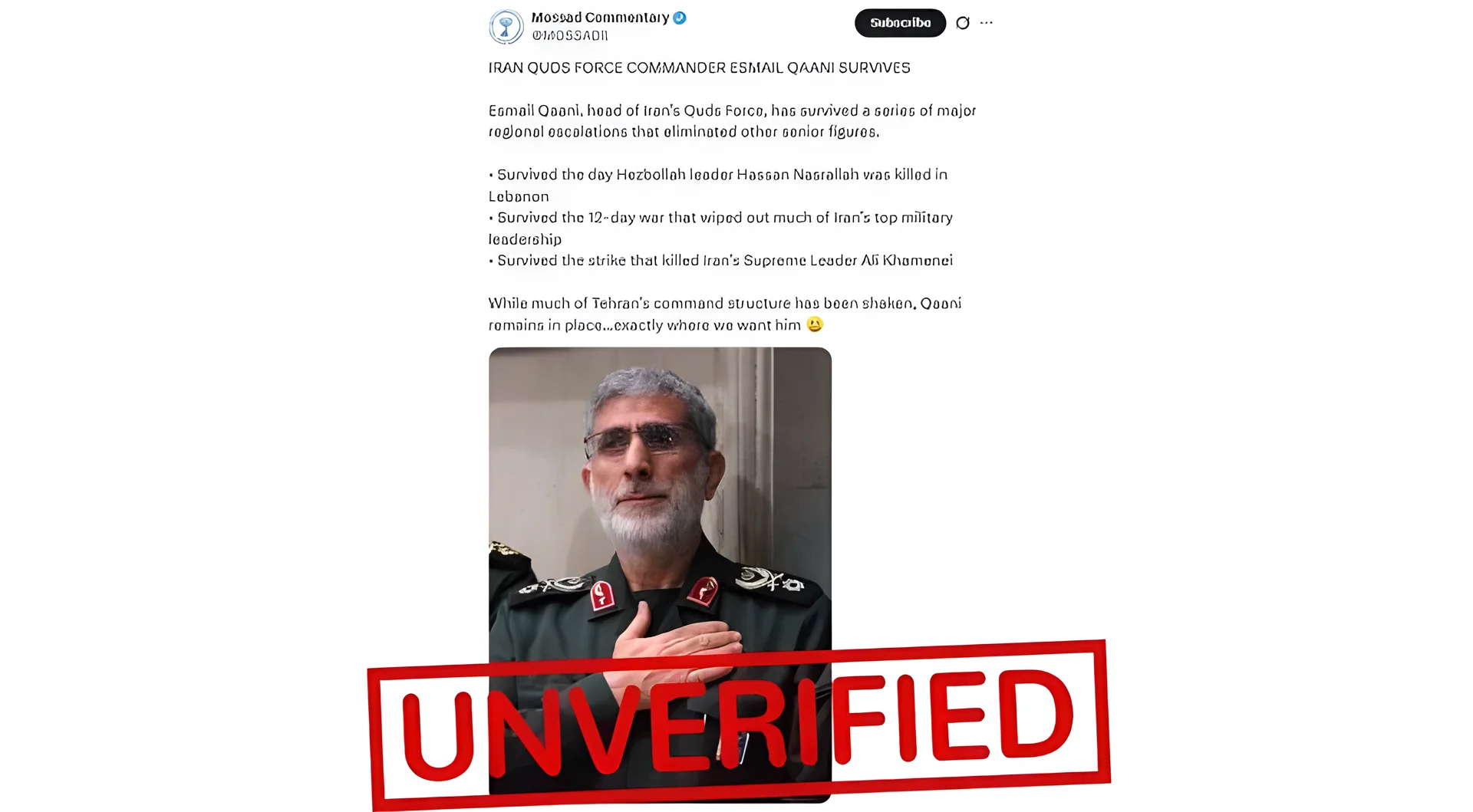
Esmail Qaani, the commander of Iran’s elite Quds Force, may have been executed following allegations that he was a spy for Israel’s Mossad, according to unverified reports. The claims have sparked international speculation about a potential internal purge within Iran’s military and political leadership.
Background on Qaani’s Disappearance
Qaani, who took over from Qasem Soleimani in 2020, has been notably absent from public view during a series of high-profile Israeli assassinations that targeted top Iranian officials, including the strike that killed Supreme Leader Ayatollah Ali Khamenei. However, Khamenei survived the attack, which has led to speculation about the role of intelligence failures.
Qaani earned the nickname ‘the man with nine lives’ after surviving multiple assassination attempts and close-call airstrikes over several years. However, his luck reportedly ran out not at the hands of foreign missiles, but through an internal investigation into security breaches.
Internal Suspicions and Mossad Allegations
Intelligence sources suggest that the Islamic Major Guard Corps (IRGC) grew suspicious of Qaani after Israel successfully localised and eliminated several top-tier Iranian officials with surgical precision. The failure to protect Supreme Leader Khamenei was reportedly the final catalyst that led investigators to look within the highest echelons of the Quds Force for a mole.
According to reports from Middle Eastern intelligence circles, Qaani was detained and interrogated over his potential ties to Mossad. The theory suggests that Qaani provided the actionable intelligence required for Israel to carry out its recent string of ‘impossible’ assassinations. The investigation reportedly focused on how Israel obtained the exact coordinates of secure bunkers and clandestine meeting locations.
Impact on Iran’s Military and Proxy Networks
If the reports of his execution are accurate, it would represent one of the most significant counter-intelligence failures and subsequent internal ‘cleansings’ in the history of the Islamic Republic. The Quds Force is the overseas arm of the IRGC, responsible for managing Iran’s ‘Axis of Resistance,’ including Hezbollah in Lebanon, Hamas in Gaza, and militias in Iraq and Yemen.
The removal of its top commander—whether by execution or incapacitation—leaves a massive power vacuum at a time when Iran is facing unprecedented military pressure from Israel. Security analysts note that Qaani’s leadership style was already seen as less charismatic and influential than that of his predecessor, Qasem Soleimani. An execution on charges of treason would likely cause deep demoralisation within the ranks of Iran’s proxy network and trigger further paranoia within the Tehran establishment.
As of Sunday, the Iranian state media has remained quiet regarding Qaani’s whereabouts. Historically, Iran has used ‘proof of life’ videos to dispel rumours about its senior leaders; however, no such footage has surfaced since the allegations began to gain traction.
International observers are now watching for the appointment of a successor, which would serve as the definitive confirmation of Qaani’s removal. Until then, the status of the Quds Force chief remains a central mystery in the escalating conflict between Iran and Israel.
The Israel-Iran conflict has already begun to have tangible effects on regions like Balochistan, where food and fuel shortages have increased by 40% due to disrupted border trade. The Indian Embassy has issued advisories for Indians in the UAE, warning against filming airports, government sites, and other sensitive locations amid the ongoing war tensions.





Comments
No comments yet
Be the first to share your thoughts