

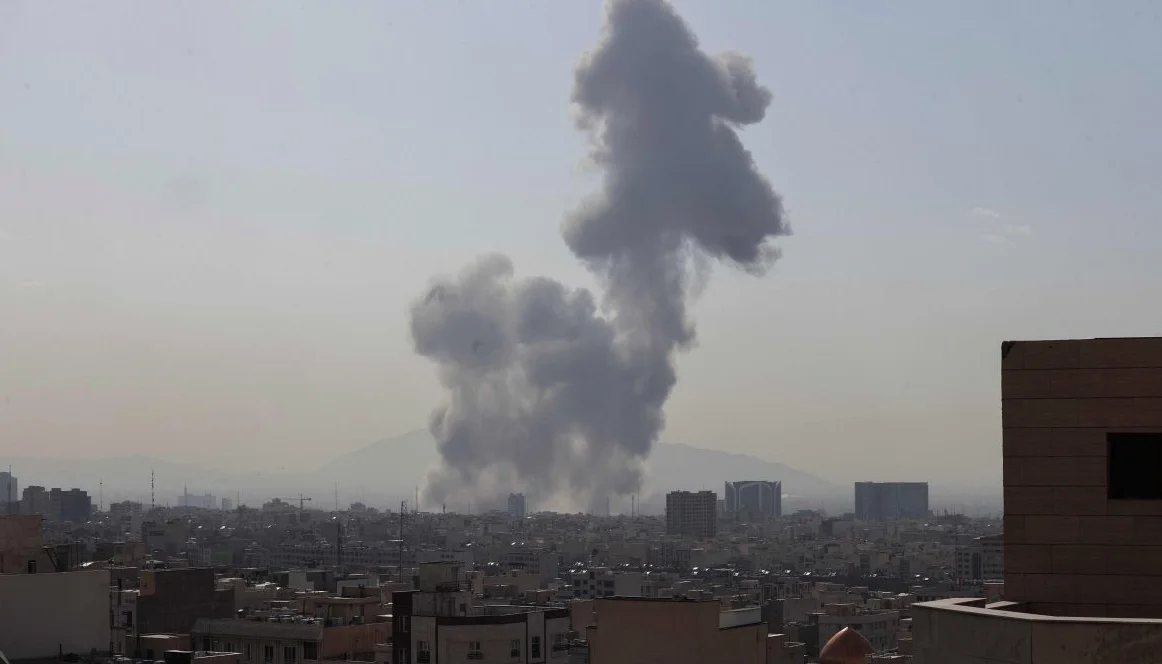
The United States and Israel launched coordinated military strikes on Iran on Saturday, triggering explosions and columns of smoke in the Iranian capital, Tehran. The attacks, which followed U.S. President Donald Trump’s frustration with Iran’s position in nuclear negotiations, marked a significant escalation in regional tensions.
Explosions in Tehran and Retaliatory Missile Attacks
Witnesses in Tehran reported hearing at least three blasts in the Pasteur district, where the home of Iran’s supreme leader, Ayatollah Ali Khamenei, is located. Smoke rose over the area, accompanied by a large security presence in the capital. According to the Israeli military, Iran retaliated by launching missile attacks.
U.S. diplomats in the Gulf and Israeli civilians were ordered to seek shelter as the strikes unfolded. An office worker, speaking to AFP on condition of anonymity, said they saw two Tomahawk missiles flying horizontally toward targets. ‘At first we heard a dull noise and thought it was a fighter jet,’ the worker said.
In Tehran, AFP journalists reported hearing blasts and seeing smoke rising over the city center. The health ministry confirmed that ambulances had been dispatched, but there was no immediate confirmation of casualties. Iranian state television reported that President Masoud Pezeshkian was ‘safe and sound.’
Trump’s Remarks and Netanyahu’s Call for Rebellion
President Trump, who was vacationing at his Florida golf club, posted a video message stating, ‘The United States’ military began major combat operations in Iran. We are going to destroy their missiles and raze their missile industry to the ground. It will be totally, again, obliterated. We’re going to annihilate their navy.’
Trump offered the Iranian military ‘immunity’ if they surrendered, warning of ‘certain death’ if they did not. He told Iranians that ‘the hour of your freedom is at hand,’ urging them to rise up and ‘take over your government.’
Israeli Prime Minister Benjamin Netanyahu echoed Trump’s message, telling Iranians that ‘the time has come to cast off the yoke of tyranny.’
Meanwhile, the exiled son of Iran’s last shah, Reza Pahlavi, expressed confidence in a victory against Iran. ‘We are very close to final victory. I want to be by your side as soon as possible so that together we can take back and rebuild Iran,’ he said in an online video address.
Regional Responses and Escalation of Tensions
In response to the strikes, Iran, Iraq, and Israel closed their airspaces to civilian traffic. U.S. embassies in the Gulf urged American citizens to take shelter. In Jerusalem, air raid sirens sounded after blasts were heard, with the Israeli military reporting that ‘an additional barrage of missiles was launched towards the State of Israel.’
Sirens also sounded in Bahrain, home to a U.S. fleet, and in the Jordanian capital, Amman. Jordan’s air force stated it was conducting an operation ‘to defend the kingdom’s skies.’
Trump had ordered the largest military buildup in decades in the Middle East, with the world’s largest aircraft carrier, the USS Gerald R. Ford, approaching the coast of Israel. The move came after U.S. and Iranian officials held talks in Geneva, where Trump said Iran was ‘not willing to give us what we have to have.’
The strikes come weeks after Iranian authorities crushed mass protests, killing thousands of people, according to human rights groups. Iran had agreed to restrictions on low-level uranium enrichment under a 2015 nuclear deal that Trump withdrew from during his first term.
U.S. Secretary of State Marco Rubio is scheduled to travel to Israel for talks on Iran on Monday, the State Department said. In a rare move, the top diplomat will travel without reporters on his plane, marking a departure from decades of precedent.




Comments
No comments yet
Be the first to share your thoughts