

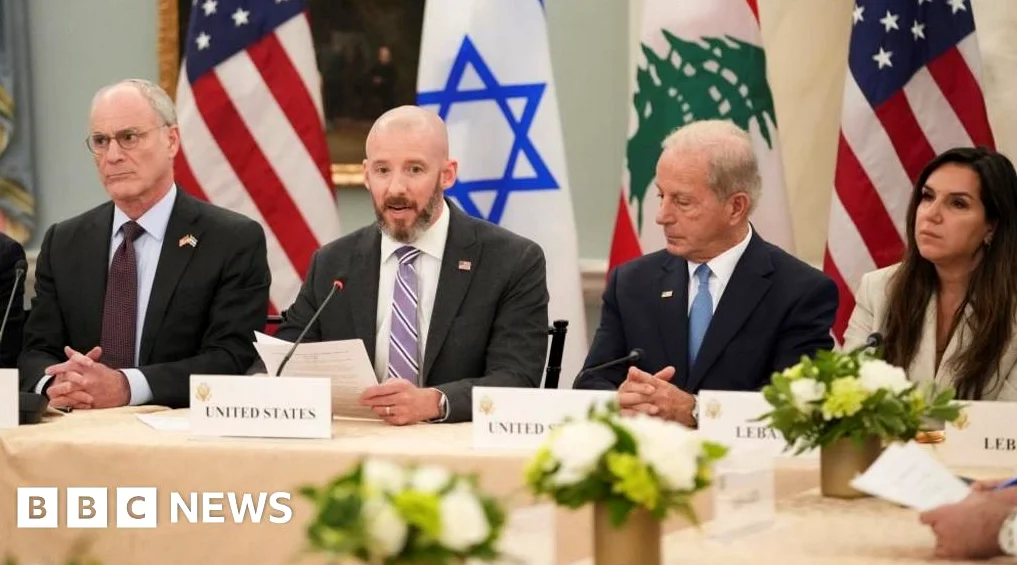
Israel and Lebanon have reached a conditional ceasefire agreement, contingent on Hezbollah halting its attacks, according to the BBC. The agreement, brokered with U.S. and French support, also requires the evacuation of Hezbollah operatives from an area in southern Lebanon under Israeli control from the Litani River to the border. The U.S. has pledged to help establish “pilot zones” where the Lebanese Armed Forces will exclusively control the territory, according to the BBC.
Contingencies and Conditions
The agreement is conditional on Hezbollah ceasing attacks and evacuating its operatives from the specified area. The Lebanese Armed Forces will be given exclusive control of the territory in these pilot zones, with the U.S. assisting in the process, according to the BBC. Israel will meet with Lebanon again on 22 June to discuss a full agreement. Hezbollah has not yet made a public statement on the agreement, according to the BBC.
U.S. Secretary of State Marco Rubio said before the announcement that he hoped the talks would produce an “action plan on a track for security in Lebanon, independent from Hezbollah.” The agreement follows a partial ceasefire announced earlier in the week, which saw Israel refrain from bombing Beirut in exchange for Hezbollah not attacking Israel, according to the BBC. However, the ceasefire was tested by both Israeli and Hezbollah fire this week, according to the BBC.
Escalation and Casualties
Lebanon’s health ministry reported that those killed by Israel on Wednesday included two paramedics whose ambulance was hit in the southern Chehour area. A car was also struck just south of the capital Beirut, according to the BBC. Meanwhile, Israel’s military said it intercepted a drone and two projectiles that crossed the border. Hezbollah claimed it had targeted a gathering of Israeli troops, according to the BBC.
Israel’s Prime Minister Benjamin Netanyahu warned that the duration of the ceasefire depends on what happens in Lebanon, according to the Kronen Zeitung. Before the ceasefire took effect, Israel had conducted particularly massive attacks on Beirut and the southern suburbs, with heavy explosions reported during the night. At 4 a.m., the explosions and warplane thundering stopped, according to the Kronen Zeitung. Hezbollah had also continued to fire rockets at northern Israel, where sirens sounded again, according to the Kronen Zeitung.
Israel’s military also bombed a Lebanese border crossing to Syria, killing two Syrian government soldiers, according to the Syrian Observatory for Human Rights. According to the Syrian state agency SANA, six people were killed—civilians and a volunteer from the Syrian Red Crescent. Israel’s army did not comment on the attacks. According to the Observatory, the aim was to cut off supply routes for Hezbollah, which obtains its weapons from Iran via Syria and other countries, according to the Kronen Zeitung.
International Involvement and Uncertainties
U.S. President Donald Trump claimed in a phone interview with ABC and on social media that he had mediated the ceasefire between Israel and Hezbollah, and that talks with Iran could conclude next week, according to the 경향신문. However, the situation remains fragile, with Israel still conducting airstrikes in southern Lebanon and U.S.-Iran naval clashes continuing sporadically. Trump said, “I think we can reach agreement next week on extending the ceasefire and reopening the Strait of Hormuz,” according to the 경향신문.
President Macron of France has also been actively involved in preventing a wider war, according to the VOI.id. He urged the U.S. to press Israel to accept the ceasefire plans in Lebanon. Macron stated that a war in Lebanon at this time would be a “huge mistake” and a “big risk of escalation.” He also sent his foreign minister to Lebanon to call for an immediate cessation of hostilities by both Israel and Hezbollah, according to the VOI.id.
Macron emphasized, “We firmly call on Israel to stop escalation in Lebanon and Hezbollah to stop shooting at Israel,” according to the VOI.id. His comments reflect broader international concerns about the potential for further conflict in the region. The BBC, Kronen Zeitung, 경향신문, and VOI.id all highlight the precarious nature of the current ceasefire and the continued involvement of international actors in de-escalating tensions.






Comments
No comments yet
Be the first to share your thoughts