

 BBC
BBC 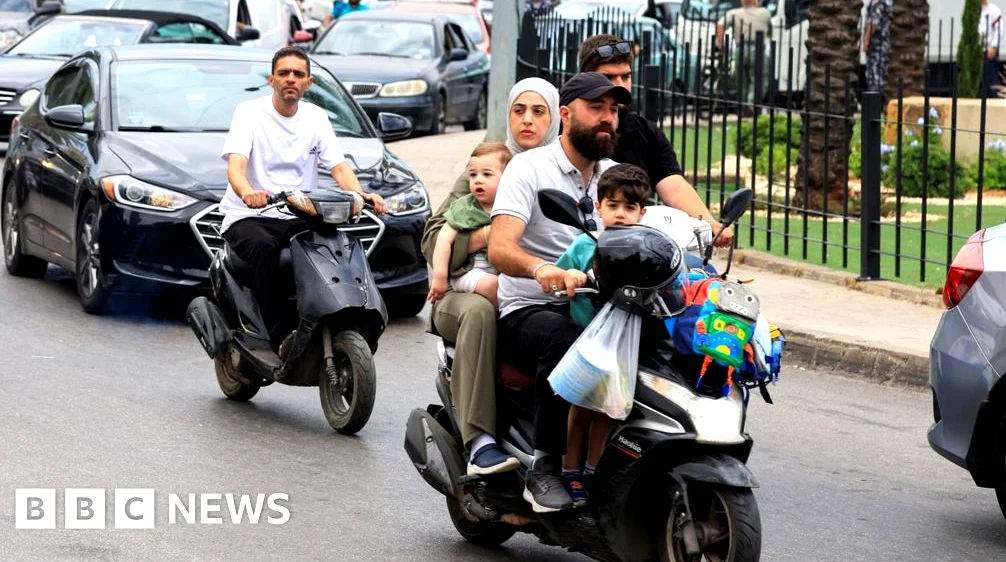
Escalation and Evacuation
Benjamin Netanyahu said “terror targets” in the Hezbollah stronghold of Dahieh would be struck; Soon afterwards, traffic jams formed on roads out of the suburbs as thousands fled to safety. The Israeli military ordered Dahieh residents to evacuate for their own safety, without giving further details.
Families, crammed into cars stuffed with suitcases, blankets and whatever belongings they could carry, streamed out of the suburbs — Two parents and their two children were squeezed on to a single scooter. Other vehicles carried several generations packed together, with babies sitting on their parents’ laps, clutching small toys as they crawled through the gridlock.
Almost everyone who slowed down enough to speak said they were prepared to stand by Hezbollah, while also doing whatever they could to protect their loved ones from the threat of further Israeli attacks.
US Diplomatic Efforts
The conflict also poses a major obstacle to US efforts to forge a deal to end its war with Iran, with Tehran insisting that any ceasefire must include Lebanon. The US has tried to separate events in Lebanon from the negotiations, but a US official said on Sunday that Secretary of State Marco Rubio had proposed a plan for “gradual de-escalation” there to Netanyahu and Lebanese President Joseph Aoun.
A senior Lebanese government official said it was relying on US mediation efforts to pressure Israel to end its own violations and prevent further civilian casualties. In a joint statement released on Monday morning, the Israeli prime minister and Defence Minister Israel Katz said they had ordered strikes on Dahieh “following the Hezbollah terrorist organisation’s repeated and ongoing violations of the ceasefire in Lebanon and its attacks against our civilians and cities”.
“The Dahieh in Beirut is no different from the communities in northern Israel — if there is no calm in the north, there will be no calm in Beirut,” Katz warned.
Casualties and Continuing Conflict
At least 3. 433 people have been killed in Lebanon since the start of the war, according to the country’s health ministry, and its figures do not distinguish between combatants and civilians. Israel says 24 of its soldiers and four Israeli civilians have been killed over the same period on both sides of the border.
In southern Lebanon on Monday. Two men were killed in an Israeli air strike in the village of Zebdine, according to the state-run National News Agency (NNA); Another five people were killed in a strike in the nearby town of Kfar Sir overnight, it said.
NNA also reported that an Israeli strike hit a building and a car park near Jabal Amel hospital in the city of Tyre, killing at least two people and injuring 23 others. A video posted on social media appeared to show damage to one of the hospital’s wards, with broken glass and debris on the floor.
Meanwhile, the Israeli military said one of its soldiers was killed in combat in southern Lebanon; Israeli media reported that he died in a drone attack.
With a US-Iran deal still proving elusive, the restraint over action in Beirut appears, for now at least, to have been lifted. There is also growing concern in Lebanon over the latest advances by Israeli forces occupying a large part of the country’s south. Their capture on Sunday of Beaufort Castle, a 900-year-old fortress, after crossing the Litani river is being viewed as a significant development.
Israeli officials have portrayed the seizure as both a symbolic and strategic victory, arguing that the high ground gives their forces a commanding view across southern Lebanon and into Israel’s Galilee region, potentially helping to counter Hezbollah attacks.
Yet despite Israel’s gains, Hezbollah has so far been able to pull back from advancing troops while maintaining its cross-border fire. The Israeli military said it had intercepted a number of suspected drones and projectiles launched towards Israeli territory on Monday. No injuries were reported.
Hezbollah said it had responded to Israeli ceasefire violations by targeting Israeli forces in the southern Lebanese town of Yahmar al-Shaqif, and by launching a missile salvo at military infrastructure in the northern Israeli town of Tiberias.
Diplomatic efforts to halt the fighting appear to have made little headway. A US official said on Sunday that Marco Rubio had spoken with Netanyahu and Lebanese President Joseph Aoun, though those discussions seem to have focused on increasing pressure on Hezbollah rather than curbing Israel’s military operations.
According to the official, Rubio proposed that, as a first step, Lebanese officials should pressure Hezbollah to stop its attacks on Israel and that, in return, Israel would refrain from escalation in Beirut. “This would create space for gradual de-escalation and an effective cessation of hostilities,” they said.
The official added that Aoun had tried to advance the proposal but that Lebanese Parliament Speaker Nabih Berri, who said on Sunday that he could “guarantee” Hezbollah’s commitment to a ceasefire, had “placed the burden on Israel to stop shooting first.”
A senior Lebanese government official told the BBC on Monday that it was relying on US mediation efforts to pressure Israel to curb its military actions and prevent further civilian casualties in Lebanon. “We are trying our best, just to stop the killing of people,” the official said, describing daily Israeli violations and the difficulty of securing tap into over developments on the ground.
The official also said a round of talks between Lebanon and Israel would still take place in Washington this week. “We don’t have another choice,” the official said. “We have to go to the negotiation and put on the table that we want a ceasefire.”



Comments
No comments yet
Be the first to share your thoughts