

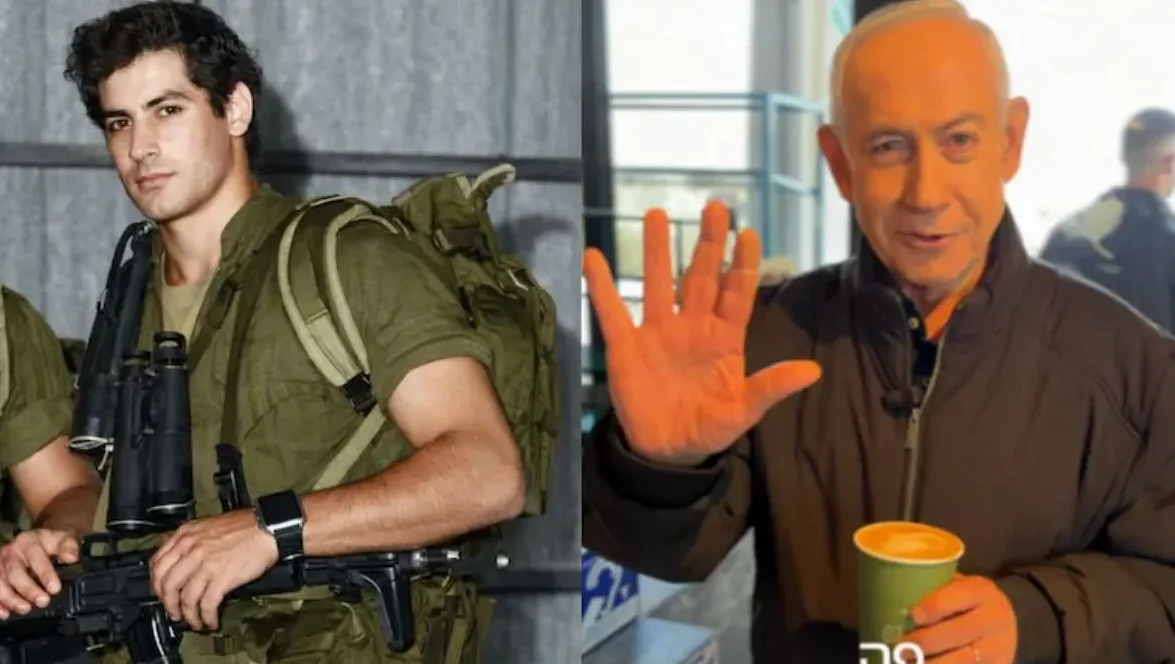
Israeli Prime Minister Benjamin Netanyahu has responded to online speculation that he has six fingers with a sharp and humorous reply on X, the social media platform formerly known as Twitter. The comments came in response to a post that claimed a recent video of Netanyahu showed him with an extra digit, raising questions about whether the footage was or not.
Controversial Video Sparks Speculation
The controversy began after a video of Netanyahu surfaced online, in which he appeared to have six fingers on one hand. The clip, which was posted on social media and quickly went viral, prompted a wave of speculation and conspiracy theories. Some users suggested that the video was fabricated using artificial intelligence, while others claimed that Netanyahu had been dead for years and that the footage was a deepfake.
One user commented in Hebrew, ‘Hey Bibi, are you so special that you’ve got 6 fingers, or have you been gone from us a long time ago?’ The comment reflected the growing online skepticism about the authenticity of the video and Netanyahu’s current status.
X’s AI chatbot was also involved in the discussion, as it flagged some of the posts as potentially fake. The platform’s system detected accounts that were spreading misinformation and fact-checked them, confirming that the claims about Netanyahu’s death were baseless.
Netanyahu’s Response and Public Reassurance
On Monday, Netanyahu addressed the speculation directly on X, replying to the post with a message that read, ‘You raised a finger here,’ accompanied by a thinking-face emoji. His response was a clever and pointed remark, suggesting that the person who posted the question had already ‘raised a finger’ in their own accusation or skepticism.
In addition to his witty reply, Netanyahu posted a separate video in which he was seen at a cafe outside Jerusalem. In the video, he was seen raising both hands to display his fingers, saying, ‘Do you want to count my fingers? You can see them here… and here. See? Very nice.’
His remarks were aimed at dispelling the rumors and providing a visual reassurance to his supporters. The video also included a comment from Netanyahu, in which he said, ‘You know what? I’m “dying” for my people. How they are behaving is fantastic,’ a line that was interpreted as both a reference to his commitment to his nation and a play on words.
The controversy comes at a time of heightened political and military tension in the Middle East. Iran has been engaged in a conflict with the United States and Israel for the last 17 days, following a series of joint Israeli and U.S. strikes. According to The Pentagon, U.S. and Israeli forces have struck over 15,000 targets across Iran since February 28, including critical infrastructure and military installations.
Public Reaction and Broader Implications
The video and the subsequent speculation have sparked a broader conversation about the role of deepfake technology and misinformation in modern politics. Many users have expressed concern about the spread of content and its potential to undermine public trust in political figures.
Experts have noted that the incident highlights the growing challenge of distinguishing between real and fake content in the digital age. ‘This is a clear example of how AI can be used to create misleading or even dangerous content,’ said one digital security analyst. ‘It’s crucial that platforms like X take proactive steps to identify and remove such content.’
Meanwhile, Netanyahu’s response has been widely shared on social media, with many users praising his quick and humorous reply. The post has garnered thousands of likes and shares, with some users joking that the prime minister had finally found a way to outwit the skeptics.
As the situation continues to unfold, it remains to be seen whether the controversy will have any lasting impact on Netanyahu’s public image or the broader discourse around AI and misinformation. However, the incident has undoubtedly brought the issue of digital authenticity to the forefront of public consciousness.
Netanyahu’s response, while brief, has served as a reminder of the power of social media in shaping public perception and the challenges that come with it. Whether the prime minister’s six fingers are real or not, the debate has already sparked a broader conversation about the role of technology in modern politics.






Comments
No comments yet
Be the first to share your thoughts