

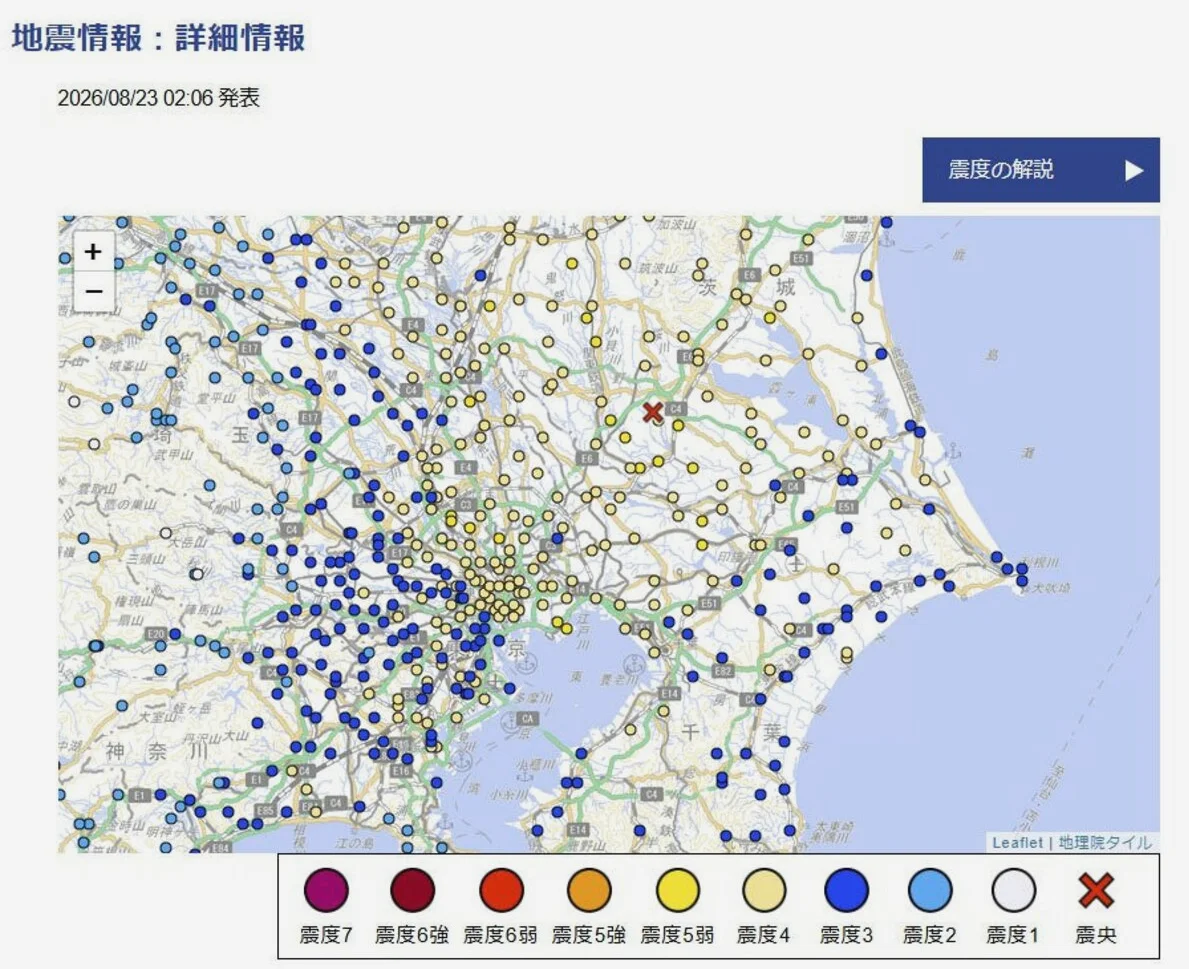
A magnitude 5.9 earthquake struck eastern Japan, including Tokyo, at 2:00 a.m. local time, according to the Japan Meteorological Agency. The quake originated in southern Ibaraki Prefecture at a depth of 68 kilometers and registered an intensity of lower 5 on the Japanese seismic scale in parts of the prefecture and central Tokyo.
Disruptions and Injuries
The earthquake caused disruptions to train services, with some services delayed and others running at reduced speeds. JR East and other operators reported delays, and the Keisei Line connecting central Tokyo to Narita Airport had returned to normal by 9:40 a.m., while some express services on the Tobu Railway remained halted. Over 20 people were injured, including a young man and a woman in her 70s in Saitama, nine in Kanagawa, and four in Chiba prefectures, according to local fire departments.
TEPCO Power Grid reported that 460 homes in Tokyo experienced power outages, though power was restored by later Sunday morning, while In Tokyo’s Koto Ward, an underground water pipe ruptured, prompting authorities to investigate possible damage from the quake. Emergency earthquake alerts were issued on mobile phones, and NHK public television showed traffic appearing normal in cities like Mito and Saitama.
Government Response and Nuclear Safety
Prime Minister Sanae Takaichi announced the formation of a government task force to assess the extent of the damage. No abnormalities were reported at the Tokai No. 2 nuclear power plant, the Fukushima Daiichi plant, or the nearby Fukushima Daini plant, according to their operators. The Nuclear Regulation Authority also confirmed no issues at other nuclear facilities across the country.
The United States Geological Survey recorded a preliminary magnitude of 5.8 for the quake; the Japan Meteorological Agency emphasized that the quake did not pose a tsunami risk. This follows a magnitude 7.1 earthquake in Kyushu last month, which killed 38 people and caused widespread damage.
Long-Term Seismic Risks
Experts warn that Japan remains at risk of a larger earthquake, and the Japanese government has identified potential catastrophic scenarios involving the Nankai Trough, a seismically active region off the country’s Pacific coast. According to the Earthquake Research Promotion Headquarters, there is a 60,94.5% probability of a magnitude 8–9 earthquake occurring in the Nankai Trough within the next 30 years, according to a report by Merkur.
Professor Naoshi Hirata of the University of Tokyo emphasized that the key question is not whether a megathrust earthquake will occur but when, but the Nankai Trough has been identified as a region where tectonic plates collide, increasing the likelihood of a massive quake.
In the wake of past earthquakes, the Kahoku Shimpo newspaper is holding a special exhibition in Tokyo to preserve the memory of the 2011 Great East Japan Earthquake. The exhibition features artwork and articles related to the disaster, highlighting the ongoing challenges faced by those affected, including the 2,500 people still missing and thousands living in evacuation shelters.





Comments
No comments yet
Be the first to share your thoughts