

 BBC
BBC 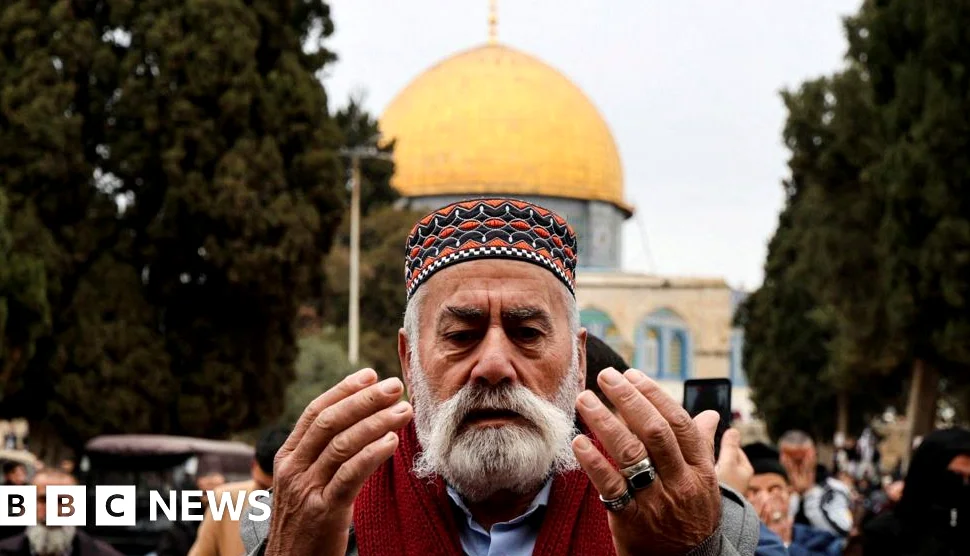
The status quo at Jerusalem’s holiest site is under threat as Israeli nationalists flout rules that have long governed the al-Aqsa mosque compound, according to BBC reports. Moshe Feiglin. A right-wing Israeli politician. Recently expressed his desire to build a new Jewish temple on the site, which has been a sacred place in Islam for 1,400 years.
Status Quo and Religious Significance
Al-Aqsa, also known as al-Haram al-Sharif to Muslims, is one of the most significant religious sites in the Middle East, as the gold-covered Dome of the Rock dominates the 35-acre site and can be seen for miles around. It is from here that Muslims believe the Prophet Muhammad ascended to Heaven, and it is a place reserved exclusively for Muslim prayer.
For Jews. The site holds equal significance as the Temple Mount; Jews pray and mourn the destruction by the Romans of the Jewish Temple on the platform above almost 2,000 years ago. The site is also linked to the Western Wall, which is a key place of Jewish worship.
Challenges to the Status Quo
Under the Status Quo. A decades-old agreement. The al-Aqsa compound is under the custody of a Jordanian-administered Islamic body known as the Waqf, as Non-Muslims are allowed to visit but cannot pray or carry out religious rites there. Most ultra-Orthodox rabbis also prohibit Jewish prayer on the site on halachic grounds.
Recent reports suggest that Israeli and US officials may be working together to abandon the Status Quo. Middle East Eye reported that a new body created by the Israeli government would declare the al-Aqsa compound a ‘multi-faith centre.’ US Secretary of State Marco Rubio denied knowledge of these reports during a Congressional hearing.
The Israeli prime minister’s office has repeatedly stated there has been no change to the Status Quo. Dr. Mustafa Abu Sway, the Deputy Head of the Islamic Waqf Council, warns that any formal change in the Status Quo could easily lead to another explosion of tension between Jews and Muslims.
International Reactions and Nationalist Movements
Jordan, Gulf countries, and Egypt have all expressed alarm at the recent erosion of Islamic authority at al-Aqsa. The British government has emphasized that the historic status quo arrangements at Jerusalem’s Holy Sites must be respected.
Israeli nationalists, however, feel emboldened. Itamar Ben-Gvir, the National Security Minister in Benjamin Netanyahu’s coalition government, recently led a Jerusalem Day march that included a group of flag-waving nationalists through East Jerusalem and the Old City’s Muslim quarter, up to the al-Aqsa compound. He sang songs and unfurled an Israeli flag, defying the Status Quo.
Ben-Gvir has used his ministerial office to permit Jewish prayers and songs in parts of the compound. He believes it is the start of increasing Jewish and Israeli control of the site. This echoes the actions of Ariel Sharon in 2000, when he walked through the Old City to the al-Aqsa compound with hundreds of armed Israeli police officers. The event is widely regarded as a spark that lit the second Palestinian intifada, or uprising, known as the al-Aqsa intifada. In the following five years, more than 4,000 people were killed in violence across Israel and the occupied West Bank and Gaza Strip.
Abu Sway, a respected Palestinian expert in Islamic studies and regional history, warns that peace without leaving al-Aqsa Mosque alone is opening a Pandora’s box. He fears that changes to the Status Quo could jeopardize the peace in the region and lead to conflict.






Comments
No comments yet
Be the first to share your thoughts