

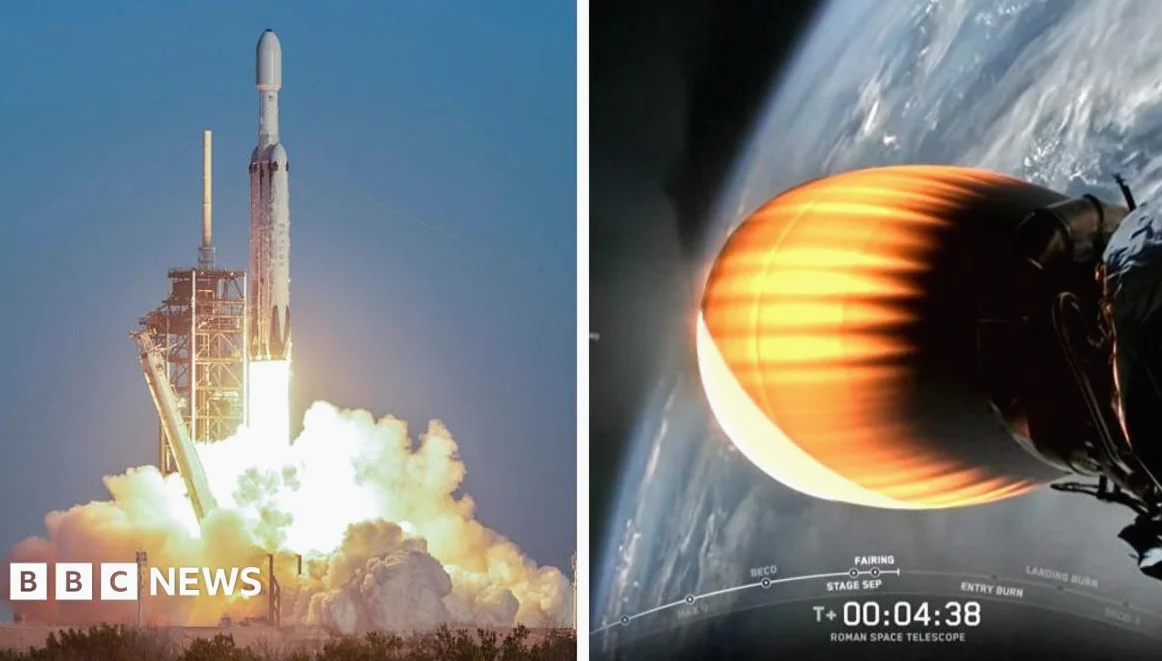
NASA launched the Nancy Grace Roman Space Telescope, named after the agency’s first chief astronomer, on a mission to explore the mysteries of the universe. The telescope separated from its SpaceX rocket about 30 minutes after launch and is now heading to its orbiting point approximately a million miles from Earth, according to the BBC.
Scientific Goals and Capabilities
Jenifer Millard, an astronomer, explained that the Roman telescope will be four times further from Earth than the Moon, where it will avoid interference from Earth and Moon infrared light. The telescope is expected to revolutionise our understanding of the universe, including investigating dark energy and dark matter, while these two mysterious forces are believed to make up about 95% of the universe, according to the-star.co.ke.
According to NASA, the telescope’s ‘crisp, sweeping surveys will help scientists investigate dark energy and dark matter, discover and characterise exoplanets, map billions of galaxies, study black holes, and explore objects from our own solar system to the edge of the observable Universe.’
During a news conference, scientist Fox said Roman ‘is going to discover tens of thousands, maybe even 100,000 new exoplanets’—planets located outside of our solar system. ‘Why do we care so much about exoplanets? Because one of our main goals at NASA is answering the question, ‘Are we alone in the universe’?’ she added.
Historical Context and Legacy
The Nancy Grace Roman Space Telescope is named after physicist Nancy Grace Roman, who was NASA’s first chief astronomer in the 1960s and its first female executive. During her career, she was instrumental in getting the Hubble Space Telescope approved by the US Congress — she also noted that its most interesting discovery was dark energy, according to the-star.co.ke.
The Roman telescope is expected to build on the legacy of the Hubble Space Telescope, which was launched in 1990 and orbits about 300 miles above Earth. The James Webb Space Telescope, launched in 2021, also orbits a million miles from Earth but has a less expansive field of vision than Roman.
Political and Public Reactions
US President Donald Trump participated in the news conference via phone call to congratulate the scientists working on the project. ‘You’re the hottest in space, and we have the hottest country anywhere in the world. So, let’s keep it all going. You’re a big part of it,’ Trump said, according to the BBC.
Jackie Townsend, a project manager on NASA’s Roman telescope, described the launch as ‘glorious’ at the post-launch news conference. ‘The ride was magnificent; it put us right where we wanted to be,’ she said. The telescope has a five-year primary lifespan, with a goal to operate for 10 years, according to the-star.co.ke.






Comments
No comments yet
Be the first to share your thoughts