

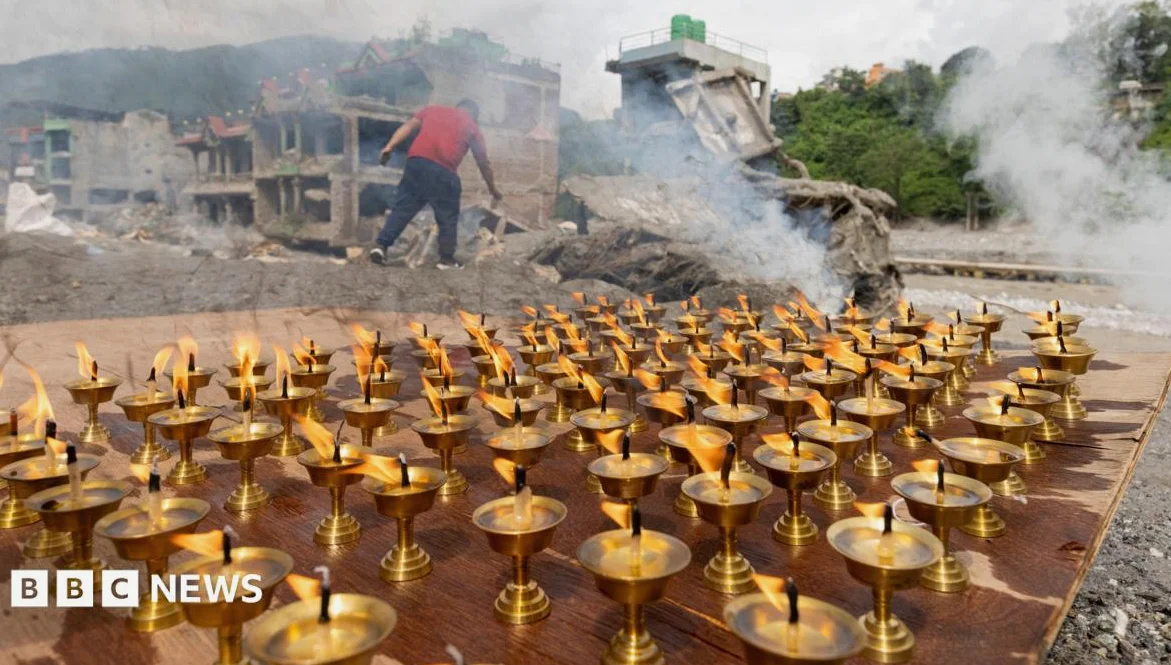
Nepal observed a national day of mourning on Monday for victims of the Aug. 26 flash floods, as the confirmed death toll across Nepal and Tibet reached at least 1,385, with more than 5,500 people still missing, according to Agence France-Presse. Government offices nationwide lowered their flags to half-staff, and families conducted traditional mourning rituals on the 13th day since the disaster.
National Mourning and Religious Traditions
In predominantly Hindu Nepal, close relatives traditionally observe a 13-day mourning period following a death; On the final day, families hold ceremonies and prayers for the departed. For families whose relatives remain missing, some have performed symbolic funeral rites even without recovering their loved ones’ bodies, according to the Associated Press.
Relatives of missing workers gathered near government offices in Kathmandu, including the prime minister’s office and key ministries, calling on authorities to accelerate the search for those still unaccounted for. Particular concern centers on workers at hydropower projects along the Bhotekoshi River, where floodwaters and debris swept through construction sites and tunnel systems.
Rescue Efforts Continue
Despite the national mourning period, Nepal’s disaster management authorities have continued search-and-rescue operations. The Nepalese Army said rescue efforts are continuing at “the same tempo” to make sure “that no one is still stranded.” These efforts include ground operations, aerial searches, and missions inside tunnel systems.
President Ram Chandra Paudel was touring flood-hit areas to survey the damage caused by the disaster. Officials have not held large-scale memorial ceremonies during the mourning period, with the focus instead remaining on locating missing persons and providing aid to those affected.
International Concern and Local Response
The glacial and mountain collapse along the China-Nepal border triggered the disaster, causing widespread destruction and loss of life; Nepal’s government has faced calls for transparency and increased efficiency in its response. Some families have expressed frustration over the slow pace of the search and the lack of information on the fate of their loved ones.
As the search continues, the government and international partners are assessing the scale of the disaster’s impact. The flood affected both Nepal and Tibet, with reports indicating that the death toll and missing persons are concentrated in border areas where hydropower projects are under development.




Comments
No comments yet
Be the first to share your thoughts