

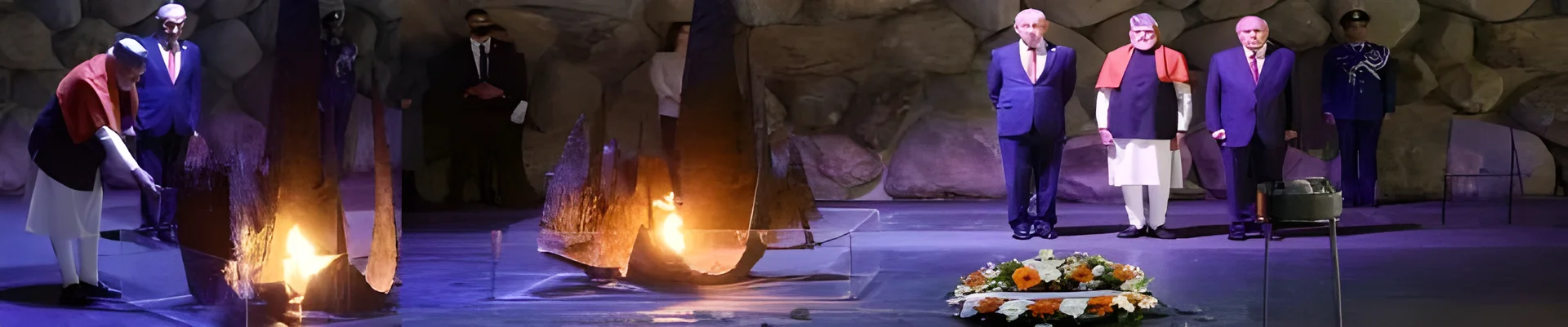
Prime Minister Narendra Modi visited Yad Vashem, the World Holocaust Remembrance Center, in Jerusalem on Thursday, February 26, 2026, during his official visit to Israel. The visit, which included laying a wreath at the memorial, underscored a deep respect for the memory of Holocaust victims and highlighted the growing strategic and emotional ties between India and Israel.
A Symbolic Gesture of Solidarity
Accompanying Modi was Israeli Prime Minister Benjamin Netanyahu, a sign of the strong personal rapport between the two leaders. The visit to Yad Vashem, established in 1953 by Israel’s parliament, is a solemn reminder of the Holocaust, during which six million Jews were systematically murdered by the Nazis and their collaborators.
Modi also visited the Hall of Names, a space dedicated to preserving the identities and stories of those who perished in the genocide. In a post on X, Modi said: ‘Laid a wreath at Yad Vashem, the World Holocaust Remembrance Center. Grateful to PM Netanyahu for accompanying me during this visit. Also visited the Hall of Names, a solemn space that preserves the memory of those who suffered and perished during the Holocaust.’
He continued: ‘The Holocaust stands as one of humanity’s darkest chapters. It is an eternal reminder of the need to uphold humanity, dignity, and peace.’
A Deepening Strategic Partnership
Modi’s visit to Israel builds on years of growing bilateral ties in areas such as defense, agriculture, water management, and advanced technology. Earlier in the day, Modi met with Israeli President Isaac Herzog, where the two leaders discussed a broad range of bilateral issues.
President Herzog echoed the sentiment of strengthening the India-Israel relationship, stating that the two nations are stronger together. Modi shared glimpses of the meeting on X, noting: ‘Glimpses from the meeting with President Herzog. Our talks were extremely fruitful and wide-ranging.’
Modi expressed full agreement with Herzog’s assessment of their joint strength and highlighted potential in emerging sectors such as technology, innovation, and startups. ‘There is immense scope in futuristic areas such as technology, innovation, Start-Ups and more,’ Modi said, pointing to collaborative opportunities ahead.
He also extended gratitude to Herzog for supporting India’s ‘Ek Ped Maa Ke Naam’ initiative, a nationwide tree-planting campaign symbolizing environmental commitment and maternal legacy.
Historic Welcome and Strategic Significance
Modi’s two-day official visit to Israel began on Wednesday with a heartfelt welcome in Tel Aviv. Prime Minister Netanyahu and his wife personally received him at the airport, where a special guard of honor was presented. This visit marks a significant milestone in the evolving relationship between the two nations.
For defense analysts, the trip highlights a notable advancement in cooperation in areas such as missile systems, UAVs, and indigenous manufacturing—key pillars of India’s strategic modernization. The visit to Yad Vashem not only honored historical lessons but also reinforced India’s stance on peace and human dignity on the global stage.
The significance of Modi’s visit lies in its symbolic and strategic implications. It reflects a shared commitment to values of peace, human dignity, and mutual respect, while also strengthening economic and defense ties between the two countries. The visit is expected to lead to new agreements and collaborations in the months ahead, with both nations looking to deepen their strategic partnership in a rapidly evolving global landscape.






Comments
No comments yet
Be the first to share your thoughts