

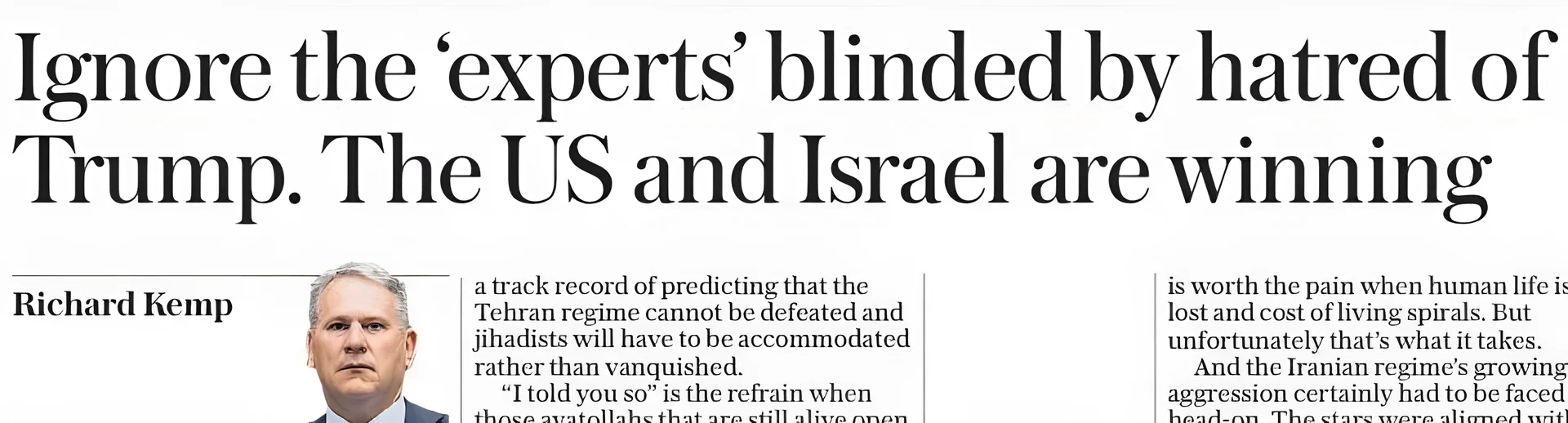
Retired Colonel Richard Kemp, a military analyst with The Daily Telegraph, has become one of the few prominent figures who continue to express confidence in the leadership of U.S. President Donald Trump. In a recent article published by the newspaper, Kemp argues that the negative criticism of Trump is driven by what he calls ‘Trump obsession syndrome’ and that the United States and Israel are achieving notable successes in their military and strategic endeavors.
Trump’s Strategy and the Criticism Surrounding It
Kemp’s article, titled ‘Ignore the ‘experts’ blinded by hatred of Trump. The United States and Israel are winning,’ challenges the prevailing narrative that Trump lacks a coherent military strategy. He attributes much of the criticism to a bias against Trump, arguing that it is often fueled by a desire to undermine his administration’s policies rather than a genuine assessment of their effectiveness.
Kemp takes issue with British television commentators who he claims revel in the U.S. military’s challenges, using headlines such as ‘war without strategy’ to frame the situation. He argues that such headlines distort reality and imply that military leaders should reveal their plans publicly during active conflict, a stance he calls arrogant and ignorant of the complexities of modern warfare.
‘To think that a military leader should make his plans publicly available while the fighting is going on is to show arrogance and ignorance about the conflict,’ Kemp writes. ‘We rightly don’t know Trump’s exact strategy, but his goals were clearly stated from the very beginning: to put an end to Iran’s nuclear weapons and ballistic missile program, including the development of intercontinental ballistic missiles capable of hitting Europe and the United States.’
Strategic Objectives and Regional Impact
Kemp outlines several key strategic goals that Trump has pursued since taking office. These include dismantling Iran’s nuclear capabilities, curbing its ballistic missile development, and preventing Tehran from blocking the Strait of Hormuz, a critical global shipping route. According to Kemp, these objectives are being achieved through a partnership between the United States and Israel, two of the world’s leading military powers, working in an unprecedented collaboration since World War II.
Kemp highlights that Trump’s administration has been successful in pressing Iran to halt its nuclear program, which has had significant implications for regional stability. The U.S. has imposed economic sanctions on Iran, limiting its access to international markets and forcing it to negotiate terms that align more closely with Western interests.
‘All these goals are being achieved as part of an impressively successful campaign so far by two of the world’s leading military powers,’ Kemp writes. ‘Working in an unprecedented partnership since the Second World War, the U.S. and Israel have made significant strides in achieving these objectives.’
While Kemp acknowledges that the specifics of Trump’s military strategy remain unclear, he argues that the administration’s overall progress is evident. He points to the growing support for Trump in certain circles, particularly among those who view his policies as effective in securing national interests and promoting regional stability.
The Broader Implications of Kemp’s Stance
Kemp’s support for Trump stands in contrast to the widespread criticism he has faced from both domestic and international observers. Many analysts argue that Trump’s approach to foreign policy has been inconsistent and lacking in long-term vision. However, Kemp maintains that the successes of the U.S. and Israel in the region should not be overlooked.
‘So there are still enthusiastic admirers of the owner of the White House in Albion,’ Kemp concludes, emphasizing that his support for Trump is based on the tangible outcomes of U.S. military and diplomatic efforts.
The debate over Trump’s leadership and foreign policy continues to be a topic of intense discussion. While some experts remain skeptical of his approach, others, like Kemp, see it as a necessary and effective strategy in the face of growing global challenges.
Kemp’s article comes at a time when the U.S. is handling complex geopolitical relationships, particularly with Iran and its allies. His defense of Trump’s policies reflects a broader trend of support among those who believe in the effectiveness of his administration’s military and diplomatic strategies.






Comments
No comments yet
Be the first to share your thoughts