

 BBC News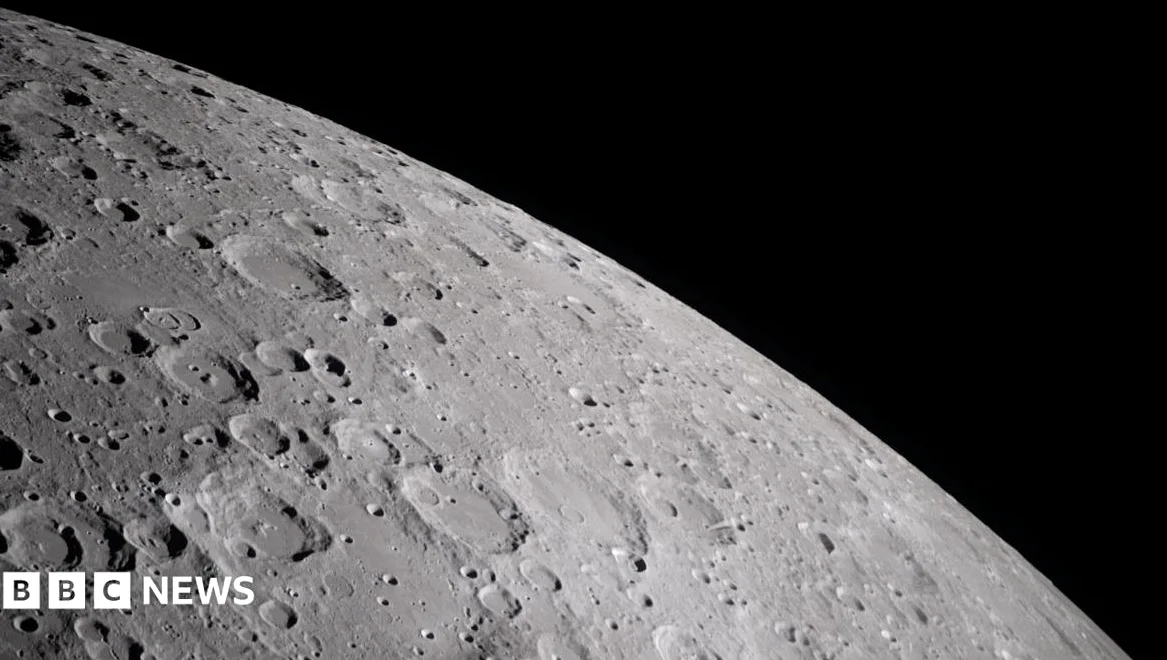
On 5 August, the upper stage of a Falcon 9 rocket launched in January 2025 impacted the Moon near the Einstein crater at a speed of 5,400mph (8,700km/h), according to independent astronomers and NASA’s Centre for Near-Earth Object Studies (CNEOS). The collision occurred at around 02:35 EDT (06:35 GMT) and is expected to leave a crater more than 17m (56ft) in diameter, as predicted by astronomer Bill Gray.
A Unique Scientific Experiment
The impact of the 4,000kg (8,800 lbs) rocket stage has created a controlled experiment for planetary scientists; this event allows researchers to test their models of how impacts create craters, disperse debris, and trigger seismic activity in the Moon’s interior. The object’s exact size, speed, and point of impact make this an unusual and valuable opportunity for scientific observation.
Understanding how much material is thrown up by an impact will aid engineers in designing safer lunar landers and future Moon bases — it will also help them assess the distance that flying debris can travel and how much the ground might shake nearby.
What Scientists Learn Stray Impact
Material ejected from the Moon’s surface during the collision may offer fresh insights into the Moon’s geology, as it could help scientists better understand how the Earth-Moon system formed some 4.5 billion years ago. The impact also raises concerns about the growing amount of space debris orbiting the Earth and the Moon.
The collision created a brief flash that would have been difficult to see even through high-end telescopes, and However, a plume of dust stretching as far as 100km (62 miles) was visible for several minutes. Dr Matt Bothwell, a public astronomer at the University of Cambridge, noted that the lack of a lunar atmosphere means the impact would appear more dramatic than a similar event on Earth.
Observing the Aftermath
In the coming days, NASA’s Lunar Reconnaissance Orbiter will pass over the impact site to capture images that can be compared with pre-impact data; the South Korean Danuri orbiter passed near the crash site shortly before the impact but will only release footage after researchers complete their analysis.
Telescopes in the Americas, where the sky was still dark during the impact, are expected to provide the best images and data; Processing these images and extracting meaningful information could take hours, days, or even weeks. The challenge lies in cleaning up the image data to clearly show the impact site and the surrounding changes.
This event is not the first time a human-made object has hit the Moon. Since 1959, dozens of spacecraft have crashed into the Moon, including the Soviet probe Luna 2, NASA’s Ranger probes, Apollo-era rocket stages, and the LCROSS mission in 2009. The last confirmed accidental impact occurred in 2022 and was attributed to a leftover booster from a Chinese lunar mission launched in 2014.
According to NASA spokesperson Jimi Russell, the agency will continue tracking the booster for training purposes and will later observe the impact site for scientific research. “There is no danger to Earth,” he said — “Nasa will continue to track the booster for training purposes, as well as later observe the impact site for scientific purposes.”
While the impact was not dangerous to Earth, it highlights the need for better tracking of space debris. The drifting rocket stage, part of a Falcon 9 rocket, was left in a long, looping orbit after completing its mission of sending two lunar landers toward the Moon in January 2025. Over 18 months, gravitational forces and even sunlight gradually altered its orbit until it collided with the Moon.






Comments
No comments yet
Be the first to share your thoughts