

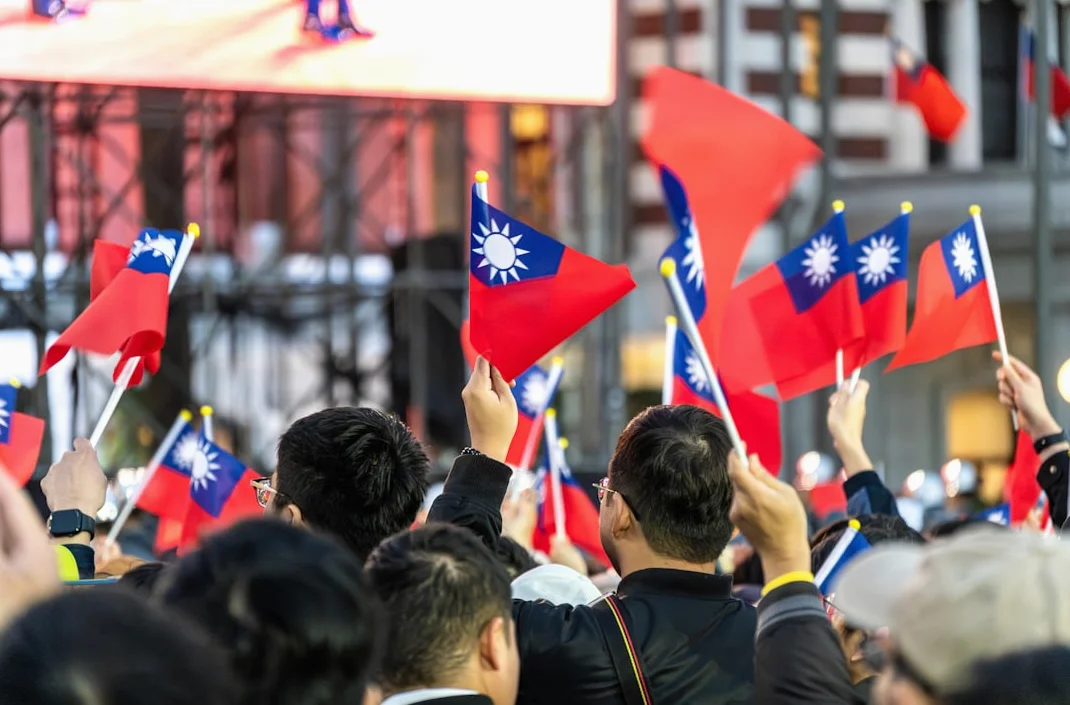
Taiwan said Saturday it is an “independent” nation, according to its foreign ministry, hours after US President Donald Trump warned the democratic island against declaring formal independence.
Trump’s Beijing Visit and China’s Pressure
Trump wrapped up a state visit to Beijing on Friday, where Chinese President Xi Jinping had pressed him not to support Taiwan, which China claims is part of its territory. Taiwan depends heavily on US security backing to deter China from carrying out its threat to annex the island by force.
“Taiwan is a sovereign and independent democratic nation, and is not subordinate to the People’s Republic of China,” the ministry said in a statement. The ministry also insisted that US arms sales were part of Washington’s security commitment to Taiwan, after Trump said it “depends on China” and was a “very good negotiating chip for us.”
Trump Warns Against Independence
Taiwan’s statements came after Trump warned the island against declaring independence. “I’m not looking to have somebody go independent. And, you know, we’re supposed to travel 9,500 miles to fight a war. I’m not looking for that,” he told Fox News’ “Special Report with Bret Baier.”
“I want them to cool down. I want China to cool down. We’re not looking to have wars, and if you kept it the way it is, I think China’s going to be OK with that,” Trump said. But he added that “nothing’s changed” on US policy towards Taiwan.
The United States recognizes only Beijing and does not support formal independence for Taiwan, but has historically stopped short of explicitly opposing independence. Under US law, the United States is required to provide weapons to Taiwan for its defense, but it has been ambiguous on whether US forces would come to the island’s aid.
Taiwan’s Defense Spending and Arms Sales
Xi began the summit with a warning about Taiwan, whose President Lai Ching-te considers the island already independent, making a declaration unnecessary. The Chinese leader told Trump that missteps on the sensitive issue could cause “conflict.”
Taiwan’s Presidential Office noted Saturday that “multiple reaffirmations from the US side, including President Trump and Secretary of State Marco Rubio, that the consistent US policy and position toward Taiwan remain unchanged.” “Taiwan looks forward to continuing to work with the US under the firm commitments of the Taiwan Relations Act,” spokeswoman Karen Kuo said in a statement.
Ahead of the summit, Trump had said he would speak to Xi about US arms sales to Taiwan, a departure from Washington’s previous insistence that it would not consult Beijing on the matter. Taiwan’s parliament recently approved a $25 billion defense spending bill to fund US weapons.
Lawmakers have said the funds will cover nearly $9 billion of the $11.1 billion arms package announced by Washington in December and a second phase of arms sales — not yet approved by the United States — worth more than $15 billion. Speaking to reporters on Friday en route to Washington, Trump said on arms sales: “I’ll make a determination over the next fairly short period of time.”
Taiwan’s foreign ministry said arms were “not only a US security commitment to Taiwan clearly stipulated in the Taiwan Relations Act, but also a form of joint deterrence against regional threats.”
Tzeng Wei-feng of the National Chengchi University’s Institute of International Relations in Taipei said the Trump administration was “leaning to China’s position” on Taiwan to improve relations with Beijing and could “change the arms sale package a little bit to show their goodwill.”
Trump “overtly stating that arms are a bargaining chip is exactly what Taiwan didn’t want to hear,” Lev Nachman, a political science professor at National Taiwan University, told AFP. “The hope is that arm sales were non-negotiable, because it’s part of the six assurances, and what Donald Trump is essentially saying is that one of those assurances no longer matters.”
Comments
No comments yet
Be the first to share your thoughts