

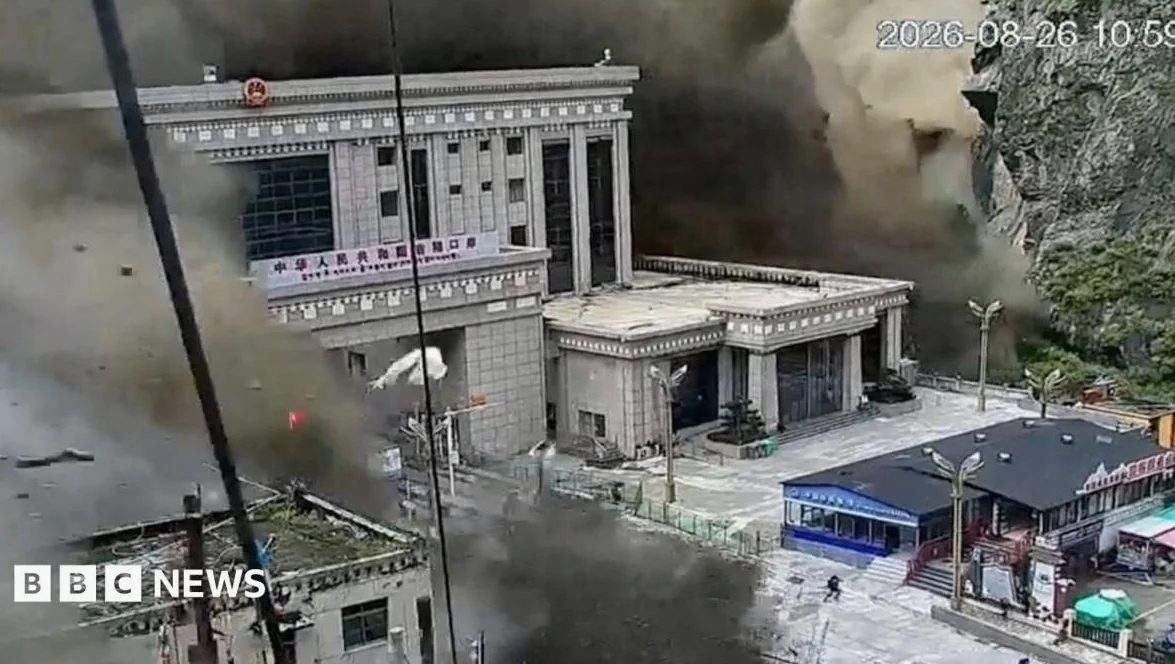
A massive flash flood in Gyirong Port,located along the China-Nepal border—has left over 150 people dead and hundreds missing — the disaster, which occurred on Wednesday, was triggered by a sudden glacial collapse, according to The Conversation. The surge of water, ice, and debris resembled a ‘tsunami of dirt’ and overwhelmed the area, sweeping away structures and lives in its path.
Restricted Visibility in China
Despite the availability of footage from CCTV cameras, the Chinese government has limited the visibility of the disaster within its own borders; According to the BBC, only a single still-frame image of the flood has been broadcast by state-run media. Social media platforms in China have also restricted the spread of video or detailed accounts of the event, with many posts about the flood either censored or removed entirely.
China has launched a large-scale rescue operation involving hundreds of emergency workers, and President Xi Jinping chaired an emergency meeting to coordinate the response; However, details about the number of victims, the extent of the damage, and the ongoing risks,such as a potentially overflowing barrier lake,remain sparse.
Glacial Collapse and Climate Concerns
Experts suggest the disaster was caused by the collapse of a glacier, a phenomenon that is becoming more frequent due to climate change; the Conversation notes that glaciers in the Himalayas, known as the ‘third pole’ for their vast ice reserves, are increasingly unstable. As temperatures rise, permafrost in the region is thawing, leading to landslides and debris flows that can trigger catastrophic floods.
The initial seismic impact of the landslide was so strong it was mistaken for a 4.4 magnitude earthquake, according to early reports. The debris flow included ice, rock, trees, and dirt, creating a devastating wave that traveled more than 170 kilometers down the Bhote Koshi River valley, connecting Kathmandu in Nepal with Lhasa in Tibet.
Political and Informational Sensitivities
Tibet has a complex history with the Chinese government, which annexed the region in the 1950s; the BBC reports that Tibet has long resisted Chinese rule, and the government has faced international criticism over human rights issues in the region. The Dalai Lama, Tibet’s exiled spiritual leader, is labeled a separatist by Beijing.
These sensitivities contribute to the limited information available about the flood and its victims. While China has provided daily updates on rescue efforts and the risks of the barrier lake, little information has been released about the dead or missing. The BBC notes that the name ‘Tibet’ is often censored on Chinese platforms, especially during events like this that draw global attention.
Meanwhile, the international community has seen more open coverage of the disaster, with video footage and social media posts circulating widely outside China; the contrast highlights the role of the Chinese internet firewall in controlling public discourse around politically sensitive events.





Comments
No comments yet
Be the first to share your thoughts