

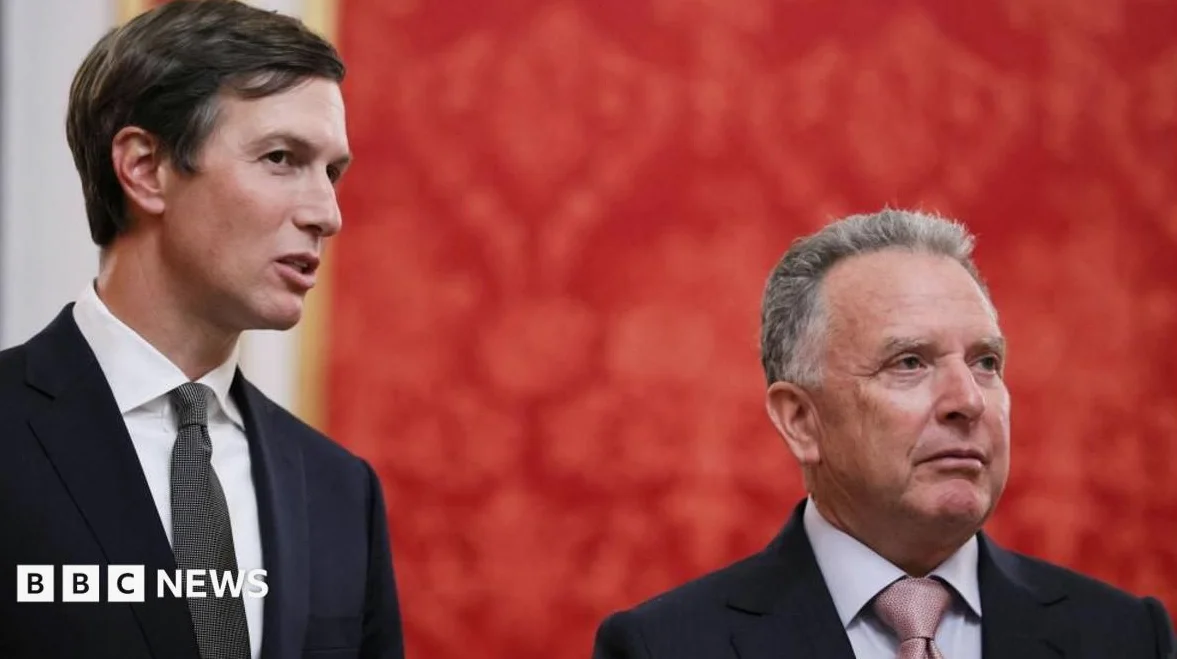
U.S. envoys Steve Witkoff and President Donald Trump’s son-in-law Jared Kushner held a three-hour closed-door meeting with Russian President Vladimir Putin at the Kremlin on Saturday. The talks, described as “useful” and “constructive” by Russian officials, were followed by dinner with Putin. A Kremlin aide, Yuri Ushakov, said the U.S. team had “prepared seriously for this trip” and expressed interest in ending hostilities as quickly as possible, offering “a whole series of considerations regarding possible paths to a settlement.”
Peace Efforts and Ceasefire Agreement
The meeting comes as part of a broader diplomatic push by the U.S. to end the nearly four-year conflict between Russia and Ukraine, while According to the Kremlin, Putin agreed to halt Russian attacks on Kyiv from Friday evening until Monday to facilitate the U.S. delegation’s visit. In a reciprocal move, Zelensky ordered a three-day halt to Ukrainian attacks on Moscow, as the ceasefire, however, is limited to the capitals and does not extend to a wider truce.
Zelensky has repeatedly highlighted Ukraine’s acute shortage of air defense interceptors, leaving the country vulnerable to Russian ballistic missile attacks; a direct strike on Friday hit the headquarters of Ukraine’s Security Service, the SBU. Despite the ceasefire, both sides remain engaged in air and missile attacks on other fronts.
Logistics and Broader Context
Witkoff and Kushner are expected to travel to Kyiv on Sunday for their first visit to the Ukrainian capital since the war began, though However, given that Ukrainian airspace has been closed since Russia’s full-scale invasion in February 2022, the logistics of their travel remain unclear. Ushakov noted that the U.S. team will use “the observations and assessments they received personally from the President of Russia” during their talks with Zelensky.
Ushakov also mentioned that the discussions extended beyond the immediate conflict, covering economic issues and potential large-scale, mutually beneficial Russian-American projects. He emphasized the need to address “the root causes of the conflict.” Meanwhile, Russian ground forces have made only slow advances in the war, despite the intensified aerial attacks, and still control about one-fifth of Ukrainian territory seized in 2022.
International Reactions and Skepticism
While the U.S. delegation’s efforts have been welcomed, there is skepticism about the likelihood of a successful peace deal. EU chief diplomat Kaja Kallas rejected the idea of former German Chancellor Gerhard Schröder representing Europe in any peace talks, calling it “not very wise” to let Russia appoint its own negotiator. Schröder, who previously held roles with Russian state-owned energy companies, had been suggested by Putin for the role.
The summer of 2024 has seen a sharp increase in civilian casualties and bloodshed, with both sides intensifying their aerial campaigns — Despite Putin’s assurance that Russia will ensure the mediators’ safety, the broader conflict remains far from resolution. A White House official said both sides “discussed substantive plans for next steps, which will be announced in the coming weeks.”



Comments
No comments yet
Be the first to share your thoughts