

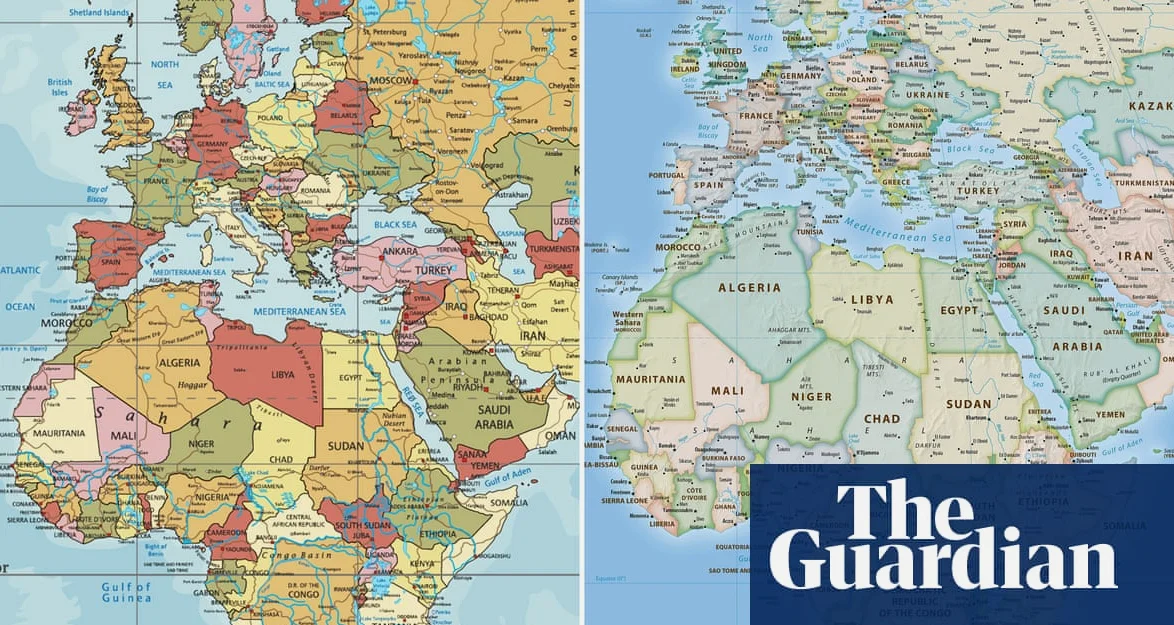
The United Nations has adopted a resolution to promote a new world map that accurately reflects the true size of Africa and other regions distorted by the Mercator projection. The resolution passed with 164 countries voting in favor, while the United States was the sole country to vote against it. Six countries abstained from the vote. The U.S. representative argued the resolution was “superfluous.”
Impact of the Mercator Projection
The Mercator projection, developed by Flemish cartographer Gerardus Mercator in 1569, has been the global standard for navigation; However, it distorts the relative sizes of regions, making those near the equator appear smaller and those at higher latitudes appear larger. For instance, Africa appears roughly the same size as Greenland on the Mercator, while in reality, Africa is 14 times larger, and this distortion has had lasting effects on global perception, education, and geopolitics.
Togo, representing the African Union, championed the campaign for the resolution, stating it recognizes the cognitive, educational, cultural, and socioeconomic effects of the Mercator projection — Togo’s foreign affairs minister, Robert Dussey, emphasized the resolution was a scientific discussion, not a political one, based on “scientific proof.”
Proposed Equal Earth Projection
The UN resolution proposes replacing the Mercator projection with the Equal Earth projection, which more accurately depicts the relative surface areas of the world’s regions. The Equal Earth projection is described as an “act of cognitive justice and memorial reparation.” The resolution notes that the Mercator projection has contributed to an unbalanced view of the world and has perpetuated the perception that regions in the Global South are smaller and less significant than they are.
Critics of the Mercator projection suggest its widespread use has helped perpetuate ideas of European superiority, as it enlarges and centers Europe and other Western regions. The resolution highlights that this distortion minimizes the extent of socioeconomic realities and infrastructure needs in the Global South and can fuel prejudices in environmental, geopolitical, and security contexts.
Non-Enforceable but Symbolically Significant
While the UN resolution is non-enforceable and does not mandate the exclusive use of the new projection, it is expected to influence educational curricula and technology platforms that currently rely heavily on the Mercator projection. The shift is anticipated to result in a more accurate global understanding of geographic scale and, by extension, the geopolitical and socioeconomic realities of regions like Africa, Latin America, and South Asia.
France has publicly supported the campaign to correct these distortions, recognizing the importance of an equitable representation of the world’s regions, and the resolution marks a step toward reevaluating how the world is perceived and represented, with the hope of promoting a more balanced global perspective.





Comments
No comments yet
Be the first to share your thoughts