

 BBC
BBC 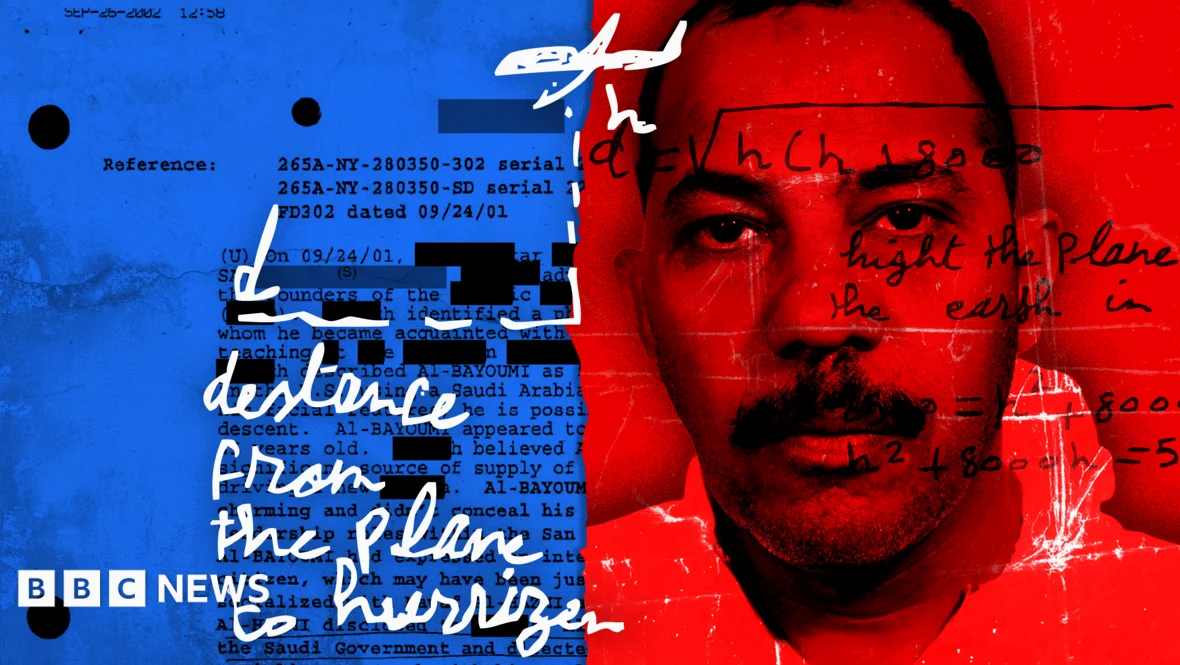
According to the BBC, newly released videos obtained by the BBC reveal that Omar al-Bayoumi, a Saudi government official at the center of a $1 trillion lawsuit brought by the families of 9/11 victims, had extensive ties to extremists and Saudi government officials. The footage, which the FBI acquired within days of the 2001 attacks, contradicts Bayoumi’s 25-year denial of being an extremist or a Saudi spy.
Paintball Sessions and Extremist Ties
In one clip, Bayoumi is seen embracing Anwar al-Awlaki, a figure who would later lead al-Qaeda in the Arabian Peninsula. In another video, Bayoumi and Awlaki are paintballing near San Diego with a Saudi Ministry of Islamic Affairs official. The BBC reported that these activities were uncovered as part of the 9/11 families’ lawsuit against Saudi Arabia, which has never been shown publicly before.
The lawsuit argues that Saudi Arabia was complicit in the 9/11 attacks and that Bayoumi aided two of the 19 hijackers who crashed planes into the World Trade Center and the Pentagon, with another crashing in Pennsylvania. Bayoumi was arrested in the UK by the Metropolitan Police days after the attacks. The videos were found among his possessions, along with other key evidence.
Hidden Evidence and Lack of Prosecution
Among the evidence found was a diagram of a plane with a flight descent equation written on it. The BBC reported that multiple FBI agents received copies of the diagram, but it was never shared with British interrogators, even though it had been couriered to the police station where Bayoumi was in custody. The diagram was also withheld from some FBI agents and from the 9/11 Commission, the independent inquiry into the attacks that killed nearly 3,000 people.
Bayoumi was never prosecuted. He and the Saudi government did not respond to the BBC’s requests for comment but have consistently denied any involvement in or prior knowledge of the attacks. The FBI also declined to comment on the matter.
After a 2018 court ruling allowed the lawsuit to proceed, thousands of documents, along with videos and photographs, were released to the court and declassified via an executive order by former President Joe Biden. BBC Panorama and Radio 4 reviewed these materials and spoke with dozens of special agents and investigators to trace the evidence the FBI gathered about Bayoumi and Saudi Arabia’s alleged involvement in 9/11. The investigation also sought to understand why the evidence was not pursued over the following 25 years.
Unreported Evidence and the FBI’s Role
According to an FBI source, the plane diagram was sent to the FBI’s New York office and analyzed. However, a Department of Justice official told the BBC he was never shown a proposal to prosecute Bayoumi based on the evidence, despite saying, “we’ve convicted people for less.” FBI agents in San Diego, where Bayoumi had lived in the U.S., repeatedly requested copies of the evidence but never received most of it. Both the San Diego and Los Angeles FBI offices were also blocked from interviewing Bayoumi’s Saudi government contacts.
Staff on the 9/11 Commission reportedly objected to the conclusion that Bayoumi was unlikely to have been involved with extremists. As a result, the report attributed this to “our investigators who have dealt directly with him.”
Bayoumi arrived in San Diego from Saudi Arabia in 1994 and claimed to be studying English. Court records show that within a few years he effectively abandoned his studies and focused on organizing religious events, often with a camcorder. One video he filmed, from 1997 or 1998, shows men including Anwar al-Awlaki paintballing near San Diego in military fatigues. At one point, some participants shout “Allahu Akbar.”
A visiting Saudi sheikh was also present in the group, and Bayoumi is heard addressing Anwar al-Awlaki with the honorific “Sheikh Anwar.” Paintballing became a focus in the FBI’s post-9/11 terrorism investigations, with the DOJ using such evidence in multiple cases. Bayoumi and Awlaki engaged in paintball sessions for at least three years in the late 1990s and early 2000s. Agents were told some participants were training for jihad.
Though Awlaki’s extremist activities became more prominent after 9/11, he already had connections to al-Qaeda operatives and was under FBI investigation before the attacks. He was killed in a CIA drone strike in 2011. Saudi Arabia has stated that the paintball video does not reveal who “made” or “took” it. When Bayoumi was remotely questioned in the lawsuit in 2021, he denied meeting Awlaki. The video evidence contradicting his claim was only made available to the court confidentially a year later and was placed on the public docket on 4 September this year.
Previously unreported footage shows Bayoumi embracing Awlaki in January 1998. Additional footage records Bayoumi meeting with officials and preachers from Riyadh’s Ministry of Islamic Affairs. He appears in a video with two ministry officials at SeaWorld, where he passes the camera to his son to record the moment. The Ministry of Islamic Affairs, created in 1993, was seen as dominated by clerics promoting a radical view of Sunni Islam and exporting it globally. It spent hundreds of millions of dollars worldwide building mosques and sending officials to the U.S., some overseeing networks of preachers with hard-line views.
After the 9/11 attacks, the FBI identified Bayoumi as an early suspect. His name appeared on an apartment rental agreement signed by the first two hijackers to arrive in the U.S., Nawaf al-Hazmi and Khalid al-Mihdhar. The FBI traced Bayoumi to Birmingham, UK, where he had moved with his family before 9/11. On 21 September 2001, officers from the Met Police’s Anti-Terror Branch arrested Bayoumi at one of his properties and transported him to Paddington Green Police Station in London. UK law at the time allowed officers to hold him for seven days without charge.
In Birmingham, police began processing evidence from Bayoumi’s properties, including thousands of documents, photographs, flight ticket stubs, phone cards, and at least 80 videotapes. Within hours, high-priority items were sent to Paddington Green, where an FBI agent was stationed. This evidence included a phone book with more than two dozen names of Saudi government officials in the U.S. and Saudi Arabia, flight simulator software, travel documents, and a yellow-lined notebook page containing a plane sketch and mathematical calculations.
Eighteen years later, the FBI turned over the notebook page to the court in the 9/11 families’ lawsuit following a subpoena. The page was made public in 2022. Jodi Westbrook Flowers, a member of the 9/11 families’ legal team, told the BBC, “It’s the mathematical calculation of the crash. When we figured out what it was, we knew the significance.”

Comments
No comments yet
Be the first to share your thoughts