

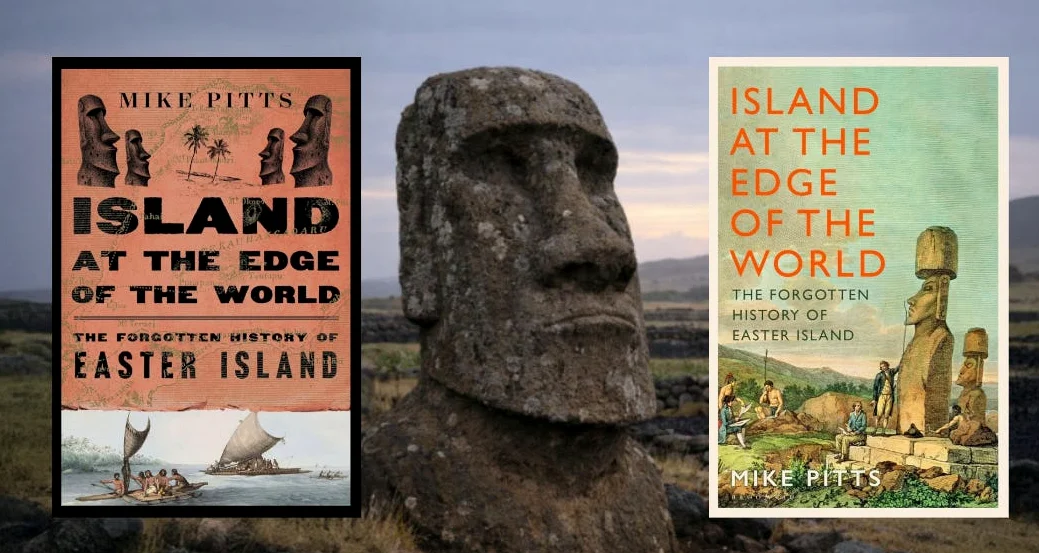
Easter Island, or Rapa Nui, is known for its massive stone statues called moai. The island’s history has often been linked to the ‘ecocide narrative’—the belief that the Rapanui people deforested the island to build the statues, leading to warfare and cannibalism. However, Mike Pitts’s book Island at the Edge of the World challenges this narrative, arguing that the Rapanui adapted resourcefully to extreme isolation before being devastated in the 19th century by slave raids, disease, and colonial dispossession, according to Substack.
Revising the Narrative of Rapa Nui
Pitts’s book opens with the consequences of European contact, including slave raids, disease, and the establishment of a sheep ranch, before analyzing how the island was studied and misinterpreted. This structure is intentional. Aiming to show that understanding the island’s past requires recognizing the violence that destroyed it and the misinterpretations that followed — the book also recovers Katherine Routledge’s archival materials, offering a more accurate picture of the island’s history.
Logistical Challenges of Rapa Nui
Rapa Nui. With a population of 8. 872 people in 2023,according to the Biblioteca del Congreso Nacional de Chile,is one of the most isolated inhabited places on Earth. Located 3,800 kilometers from the South American continent, the island’s logistical challenges include sporadic and costly maritime and air services, and According to Margarita Amaya, Director of Corporate Management at Conecta Logística, the intermodal logistics options are nearly nonexistent.
The island’s remote location and difficult terrain mean that many essential products, such as livestock and horticultural goods, must be imported. Strong waves, insufficient infrastructure, extreme weather, and hard-to-access terrains exacerbate these challenges. Despite the fertile land, the island’s dependence on imports makes it vulnerable to supply chain disruptions.
Reinterpreting the Moai Statues
The moai statues of Rapa Nui have traditionally been seen as symbols of strong central authority and a hierarchical society. However, recent research published in PLOS One challenges this view. A team from Binghamton University, Arizona State University, and the Rapa Nui community used high-resolution 3D modeling to analyze the Rano Raraku quarry, where over 95% of the moai were carved.
Contrary to the assumption that the statues were produced under central control, the research found that multiple autonomous groups worked simultaneously on different parts of the quarry. This decentralized approach suggests a different form of social organization than previously thought. The study, which used over 11,000 aerial photographs from DJI Mavic 3 Enterprise drones, revealed a complex and distributed system of labor and production.
These findings challenge the traditional view that the moai were the result of centralized power. Instead, they suggest that the statues were a product of a more distributed and collaborative society. The research team worked from June 2023 to January 2024, capturing detailed images at low altitudes to create the 3D model.






Comments
No comments yet
Be the first to share your thoughts