

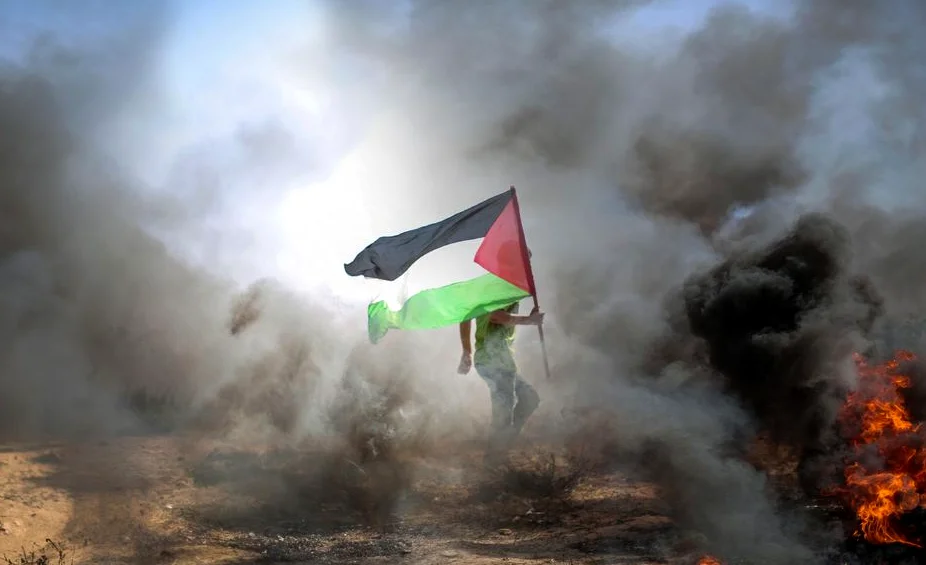
A mass funeral was held in Deir al-Balah, where more than 100 coffins wrapped in Palestinian flags were arranged in rows on the ground — Mourners prayed for the victims before carrying the bodies through rubble-lined streets to a nearby cemetery for burial, according to The Guardian.
Mass Graves and Missing Relatives
The victims had been among more than 300 people killed when Israeli warplanes demolished a residential block in Gaza City. Initially, only about 40 bodies could be recovered by people at the scene, who dug through smoldering rubble with their bare hands and basic tools. Last weekend, Gaza’s civil defense recovered the remains of a further 112 victims, including women and children. At least 157 people are still missing after the attack.
Zaher al-Waheidi, head of the Gaza health ministry’s records department, told the Associated Press that at least 7,400 people have been reported by relatives as still buried under the rubble. He added that the true number was likely thousands higher because some strikes had killed entire families, leaving no loved ones to report them missing.
Humanitarian Toll and International Condemnation
The ceasefire established in October has allowed first responders to dig through rubble where thousands of remains are still buried across the territory. A UN commission, Human Rights Watch, and Amnesty International have found that Israel committed genocide in Gaza. In June, a UN commission found that Israel was continuing to commit genocide in Gaza and that its security forces “deliberately targeted and killed” Palestinian children.
Among the mourners was Maryam Hassan al-Balawi, who stood before the remains of her family members. Malak, her only surviving daughter, stood beside her. “My husband and my children were killed. I have no one left except my only surviving daughter, Malak,” Balawi told Anadolu. “My whole life is gone. My husband and my children are gone. I have no life left,” she said, adding that Malak still cries every day for her father and siblings.
Balawi also recalled a final request from her husband before he was killed. “If I die, shroud me with your own hands and bury me with your own hands,” she recalled him telling her. For more than two years, she could not fulfill that wish. “What am I supposed to do? My home is gone, my children are gone, my life is gone,” she said.
Yet recovering the remains brought a measure of relief after years in which Balawi repeatedly returned to the ruins where her family remained buried. “When they brought them out, I felt some relief in my heart, as though my soul came out with them,” she said, according to TRT World.
Challenges in Recovery Efforts
Civil Defense crews in Gaza are working with only a handful of excavators and worn-out equipment because of Israeli restrictions on the entry of machinery needed for recovery operations. The remains were recovered in recent days from homes belonging to the Rahim, Balawi, Malaka, and Qanbour families as part of a project to retrieve Palestinians still buried beneath buildings destroyed during Israel’s war on the enclave.

Comments
No comments yet
Be the first to share your thoughts