

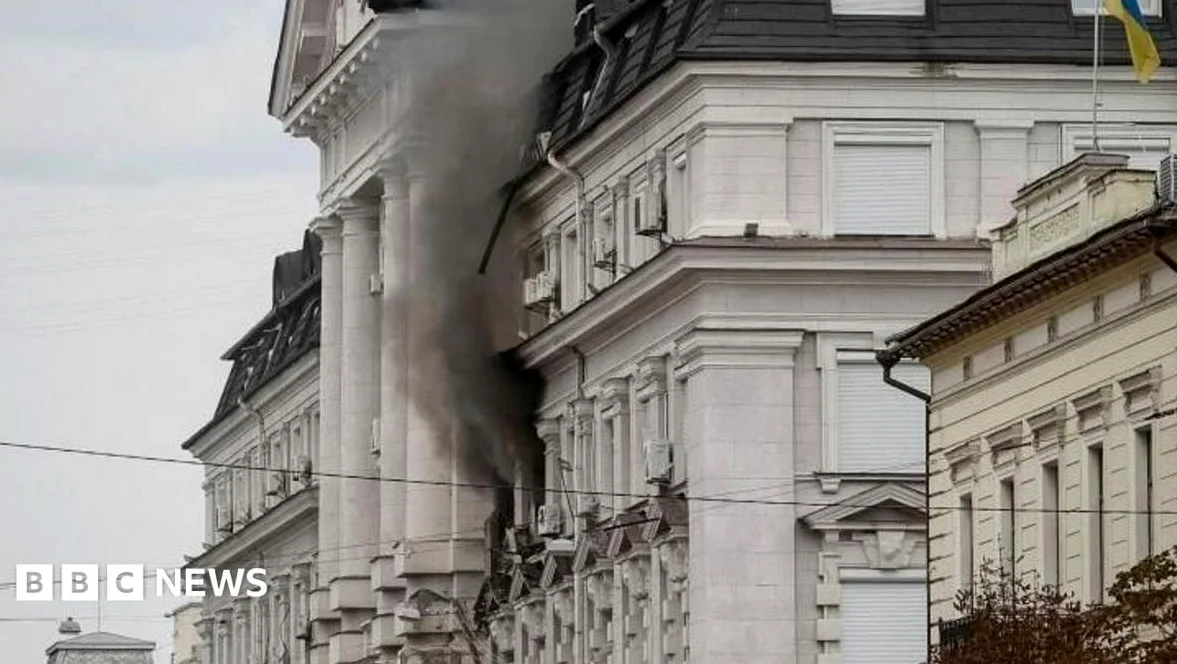
Russian drones struck the headquarters of Ukraine’s Security Bureau (SBU) in Kyiv, according to President Volodymyr Zelensky, who said the attack was a sign of Moscow’s growing capabilities and its rejection of diplomacy. ‘The drone was aimed directly at the office of the Head of the Security Service in that building,’ Zelensky confirmed in a Telegram post. He instructed SBU chief Ivan Poklad to deliver a ‘tangible response’ once ready.
Escalation and casualties
Kyiv Mayor Vitali Klitschko reported five people were injured in the strike, though he did not specify if they were inside the SBU building. A nearby café was also damaged, with one customer taken to the hospital. Stanislav Zavertaylo, co-owner of the Zavertailo chain, said this was the third of his cafés to be hit since the war began.
Foreign Minister Andriy Sybiha called the attack a ‘major escalation that demands resolute responses,’ noting it occurred during a renewed push for peace negotiations. ‘Moscow launched this strike during a renewed push for peace—laying bare its true rejection of diplomacy,’ he said.
Military adaptations and cross-border strikes
Both Ukraine and Russia have been adapting their tactics, including the use of modified aircraft and drones. In one notable example, a Ukrainian group led by aviation enthusiast ‘Goronych’ has repurposed single-engine planes into long-range drones carrying basic bombs. These aircraft recently targeted an explosives factory in Dzerzhinsk, Russia, and a mechanical plant in Saransk, nearly 800 kilometers from the border.
The Russian military has also begun using small planes equipped with machine guns in occupied territory to intercept Ukrainian drones. Meanwhile, Ukraine’s Chief of Staff, Oleksandr Syrskyi, has acknowledged the effectiveness of light aircraft in countering Russian drone attacks and has considered expanding their use.
Recent Russian strikes have also extended into Ukraine’s Black Sea ports. The Russian Defense Ministry claimed it struck a cargo vessel in the port of Chornomorsk and a tanker near Odesa. Ukraine’s Air Force reported 201 drones launched overnight from Saturday to Sunday, with 167 shot down, according to Zelensky, while Russia claimed to have downed 63 Ukrainian drones.
Victory Day tensions and diplomatic concerns
With Russia’s annual Victory Day parade scheduled for May 9, the Kremlin has taken unusual precautions. For the first time in Vladimir Putin’s tenure, no military equipment—such as missiles, tanks, or armored vehicles,will be displayed in the Red Square parade. Mobile internet in Moscow will be cut off on the day of the parade, according to reports, reflecting heightened security concerns.
Experts suggest the decision to scale back the parade may be due to Kyiv’s growing ability to strike deep into Russian territory. The Kremlin has also reportedly feared a potential coup or a drone strike that could be framed as a Ukrainian attack. International media have speculated that the move signals Moscow’s growing unease with the war’s trajectory.
Meanwhile, foreign embassies in Kyiv continue to operate despite Russian threats. The U.S. State Department confirmed it has no plans to evacuate personnel, stating, ‘The State Department has no higher priority than the safety and security of Americans and regularly reviews the security posture of Embassy Kyiv.’ France, Germany, the United Kingdom, and Japan also confirmed continued operations. However, former Russian President Dmitry Medvedev mocked the EU’s decision to keep diplomats in Kyiv, suggesting they ‘have diplomats to spare and need to trim the headcount.’
President Zelensky has previously warned that Russia is preparing potential strikes on the President’s Office building in central Kyiv. A recent attack on the city killed two people and injured over 80 others, with strikes reported in nearly every district. Albania confirmed that its ambassador’s residence in Kyiv was damaged in the attack.
As the war enters its fourth year, both sides continue to adapt, with Ukraine responding to Russian strikes and Russia adjusting to Kyiv’s growing reach. The balance of power appears to shift with each new tactic and escalation.





Comments
No comments yet
Be the first to share your thoughts