

 BBC
BBC 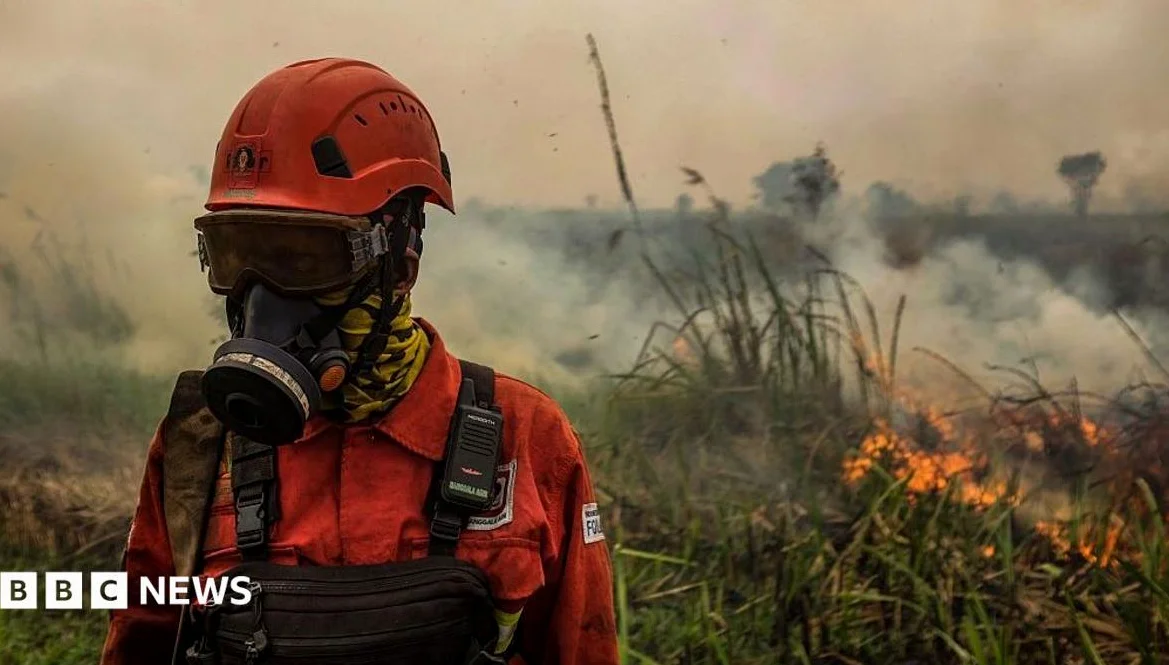
A toxic haze from weeks-long wildfires is spreading across Indonesia, Malaysia, Singapore, and the Philippines, worsening due to a ‘super’ El Niño intensifying drought conditions — Millions of people in Southeast Asia have been exposed to pollution levels more than 15 times the World Health Organization’s recommended limit.
Health Impact Rises
Between July and August, Indonesia’s Health Ministry recorded over 50,000 cases of respiratory infections linked to the fires, with more than 12,000 of those cases involving children under five years old. Rizma Nur Fatimah, a 19-year-old teaching assistant in Banjarbaru, South Kalimantan, described the smog as so thick that visibility in her classroom was nearly impossible.
“Even inside the house, with everything closed, the haze still got in,” she said. “We’ve been living with this since I was born. It’s the same every year, so we’ve almost become resigned to it. But this year is worse.”
Misbah, a 23-year-old mother from Pengayuan village, said her three-year-old daughter developed a cough, sore throat, and runny nose due to the haze. In Palawan, Philippines, residents reported similar symptoms, including itchy eyes, nose, and throat. Dr. Precious Bañas-Melad noted mild headaches and unexpected allergies among her family.
Historical and Environmental Context
Indonesia’s forest and peatland fires are not new. Experts trace the crisis to decades of land-use changes, including large-scale development projects during the Suharto era. Today, industrial plantations and commercial land use are often associated with large-scale fires. Environmental groups and researchers have repeatedly alleged that some companies use fire as a cost-effective way to clear land.
Drained peatlands, industrial timber estates, and oil palm plantations can make areas more vulnerable to burning, with fires often recurring in the same areas. Unlike traditional, community-managed practices, large-scale fires are harder to control and cause more extensive environmental and public health impacts.
Wildfires in Indonesian Borneo are particularly concerning because they burn through one of the world’s largest tropical peatland ecosystems. Normally, these peatlands store vast amounts of carbon. But under drought and El Niño conditions, they can become carbon ‘bombs,’ releasing stored carbon into the atmosphere rapidly.
Projected Escalation and Government Response
Professor Bambang Hero Saharjo, a forest fire forensics expert, noted that last year’s fires torched 359,000 hectares without El Niño. This year, with the current El Niño, fires could burn up to 11 million hectares, comparable to the 1997-1998 wildfire season, one of Indonesia’s worst on record.
Indonesia’s forestry minister, Raja Juli Antoni, said the battle to extinguish the current wildfires is entering a critical phase. “Our problems are not over. September is the peak of El Niño,” he said. “September is the main fight for us.”
With the El Niño expected to escalate, the risk of worsening fires remains high, threatening public health and the environment across the region.


Comments
No comments yet
Be the first to share your thoughts