

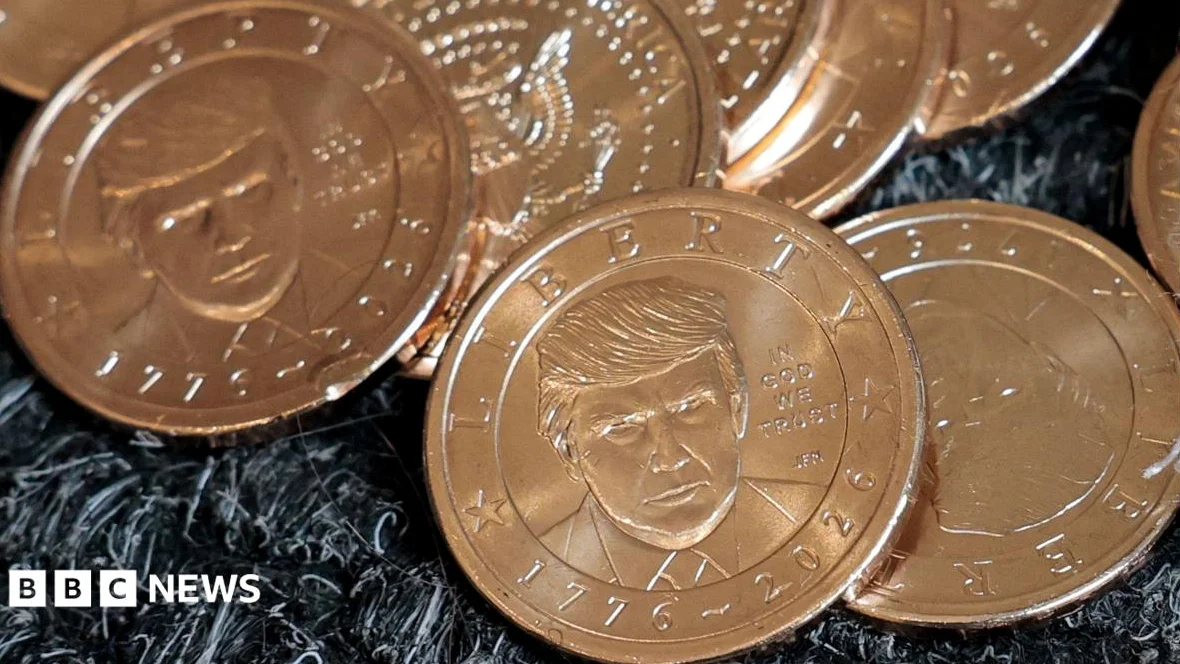
The U.S. Mint announced Wednesday that $1 coins featuring President Donald Trump’s likeness have entered circulation and can be purchased on its website, a historic and controversial move for a living president that has not been done in 100 years. According to ABC News, the coins commemorate the 250th anniversary of the signing of the Declaration of Independence, with inscriptions ‘1776 ~ 2026,’ ‘LIBERTY,’ and ‘IN GOD WE TRUST.’
Availability and Design Details
The $1 coins go on sale on Sept. 2 at 12 p.m. ET. According to USA Today, collectors can purchase 100 coins for $154.50 or a roll of 25 for $61.00. Dispersed among the bags and rolls are 250,000 coins pressed on the Fourth of July, with a ‘July 4’ privy mark, the Treasury said in a news release.
The coins feature Trump’s official White House portrait and are described as the first in a slate of Trump-adorned currency announced by the Treasury; the agency has also proposed a $250 bill and a 24K gold commemorative coin with the president’s image, as reported by USA Today.
Legality and Criticism
Some Democrats and coin collectors have questioned the legality of the coins, pointing to a federal law allowing ‘only the portrait of a deceased individual’ to appear on U.S. currency and securities, as stated in USA Today. The Treasury, however, has pointed to a 2020 law allowing it to mint a $1 coin honoring the nation’s semiquincentennial for one year.
George Washington refused to have his image printed on currency during his lifetime, believing it was ‘monarchical.’ President Calvin Coolidge was the last and only other sitting executive to appear on currency. In 1926, for the country’s 150th anniversary, the Treasury issued a half-dollar featuring Coolidge and George Washington, according to USA Today.
Neither the $1 gold coin nor the 24K gold commemorative coin received approval from the Citizens Coinage Advisory Committee, a nonpartisan group created by Congress to advise the Treasury on coin designs. That committee declined to review both coins, arguing that putting a sitting president on currency was against the country’s founding principles, as reported by USA Today.
Technical and Historical Context
While described as ‘gold coins,’ the $1 tokens don’t contain any precious metals — the coins are not real gold, but feature a gold-colored finish made of manganese brass. They were produced at the Philadelphia Mint, according to ABC News; It’s not clear how many coins were produced.
The Mint said 250,000 of the coins have a special ‘July 4th’ marking, which were randomly included in the rolls and bags and were struck on July Fourth at the Philadelphia Mint, according to the Mint’s website.
While living presidents are generally barred from appearing on U.S. currency, the Trump administration has argued that the Circulating Collectible Coin Redesign Act of 2020 permits the design because it authorizes the Treasury secretary to oversee the minting of special coins for the nation’s Semiquincentennial. According to the Mint, the same law bars any person from appearing on the tail side of a coin, but the restriction doesn’t apply to its face — which is where Trump’s likeness appears on the new $1 coin.






Comments
No comments yet
Be the first to share your thoughts